
Table of Contents
- What Jobs Are Most Exposed To AI Disruption?
- Why Is Financial Security At Risk?
- What Are The Key Statistics On AI And Women’s Jobs?
- What Solutions Are Emerging Globally?
- Which Leaders Are Driving Change?
- What Is the Choice Ahead?
- FAQs
1. What Jobs Are Most Exposed To AI Disruption?
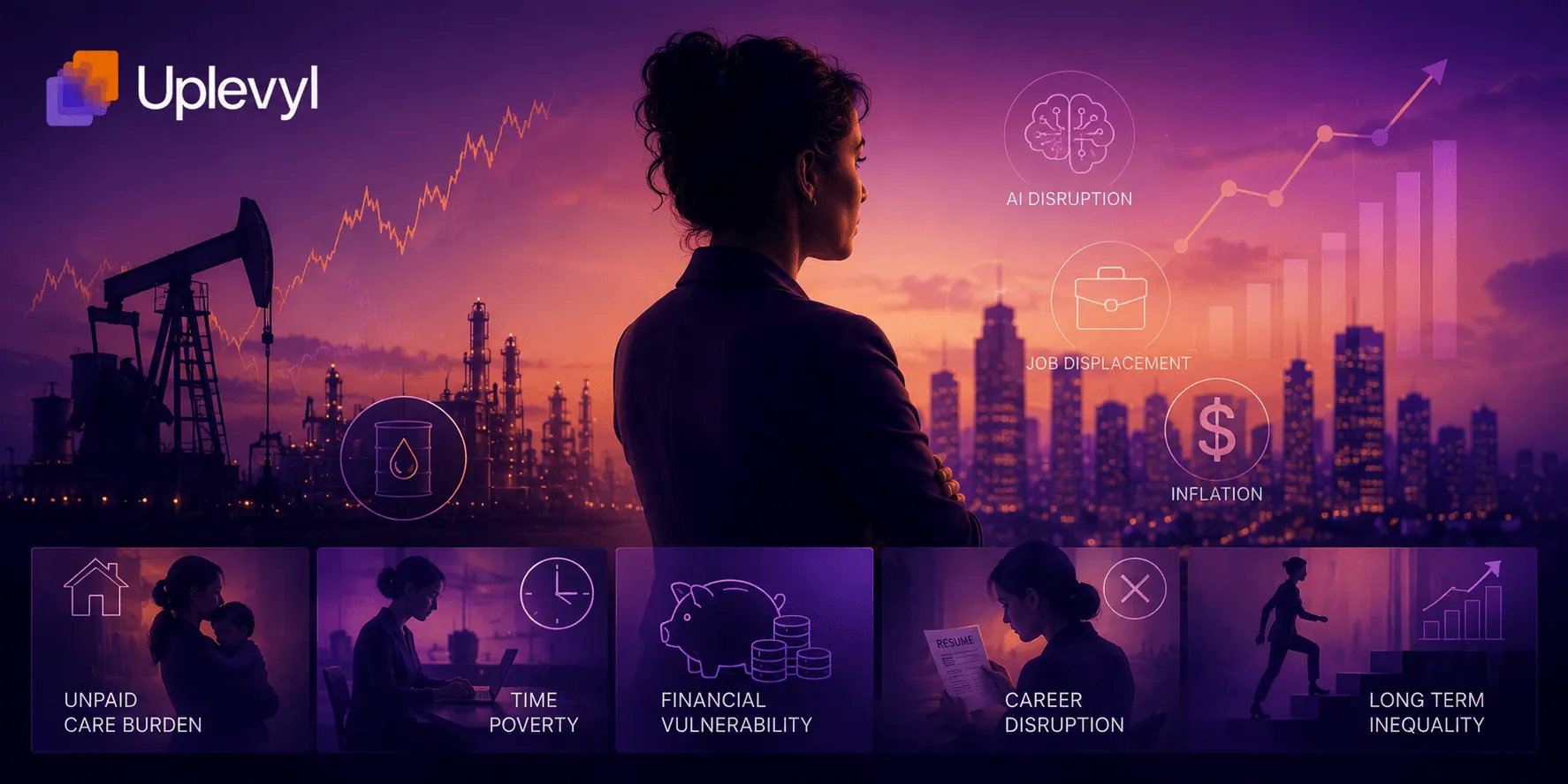
AI is transforming industries not by eliminating entire jobs but by automating tasks within them. Women are especially affected because they are more concentrated in roles undergoing rapid automation:
- Administrative And Clerical Work: Scheduling, correspondence, and documentation are being automated through AI assistants and chatbots.
- Customer Service And Back-Office Roles: AI tools manage inquiries, claims, and processing.
- Professional Pathways: Law, healthcare administration, and accounting are evolving as AI accelerates compliance, diagnostics, and research.
The International Labour Organization reports that women are more likely than men to hold jobs at higher risk of automation, and less likely to be involved in building these technologies.
2. Why Is Financial Security At Risk?
The disruption is not only about wages. Broader financial well-being is at stake:
- Women often retire with 30% less wealth than men, meaning career disruption magnifies long-term challenges.
- Caregiving responsibilities can make retraining harder to access.
- Income shocks affect families, since women reinvest much of their earnings in healthcare, childcare, and education.
Without careful planning, AI risks deepening existing economic vulnerabilities.
3. What Are The Key Statistics On AI And Women’s Jobs?
Recent findings reveal the scale of the issue:
- In high-income countries, 9.6% of women’s jobs are highly exposed to AI, compared with 3.5% of men’s jobs.
- Globally, women are nearly twice as likely as men to face severe job disruption.
- In the U.S., 95% of administrative assistants are women — a role ranked among the most automation-prone.
- Women are 20% less likely than men to adopt generative AI tools, widening future skills gaps.
(Sources: ILO, World Bank, national labor reports)
4. What Solutions Are Emerging Globally?
Governments, businesses, and innovators are testing ways to prepare the workforce:
- Singapore: Upskilling programs for mid-career professionals.
- Europe: AI Act introduces worker protections and transparency measures.
- IBM And Accenture: Internal AI training initiatives for employees.
- Uplevyl’s Future Forward Accelerator: Combines AI fluency with leadership development to prepare professionals for new opportunities.
5. Which Leaders Are Driving Change?
Prominent leaders are shaping the global response:
- Reshma Saujani, founder of Moms First, advocates childcare investment to sustain workforce participation.
- C. Nicole Mason, CEO of the Institute for Women’s Policy Research, champions policy solutions for workplace resilience.
- Shellye Archambeau, Fortune 500 board director, promotes mentorship and upskilling in disrupted industries.
These voices highlight that the future of AI and work will be shaped by leadership and policy choices as much as by technology.
6. What Is the Choice Ahead?
The automation wave is unstoppable — but its impact is still in our hands. AI could be a great equalizer, expanding opportunity, or a divider, widening gaps.
At Uplevyl, we are committed to helping women professionals build AI fluency, leadership skills, and confidence to thrive in this new economy. When women succeed in the future of work, organizations and economies succeed with them.
7. FAQs
1. How is AI impacting women’s jobs and career paths?
AI is transforming women’s work by automating tasks in administration, customer service, law, healthcare, and finance—roles where women are overrepresented. While some opportunities are emerging in AI-related fields, many women risk job displacement if reskilling opportunities remain limited.
2. Why are women more financially vulnerable to AI disruption?
Women already face a persistent wealth gap and are more likely to work part-time or take career breaks for caregiving. When AI reshapes job markets, these factors compound—reducing lifetime earnings, retirement savings, and access to retraining or higher-paying tech roles.
3. What are the most at-risk job categories for women due to AI automation?
Jobs in administrative support, clerical work, data entry, customer service, and compliance are among the most exposed. The International Labour Organization reports that women are nearly twice as likely as men to hold roles with high automation potential.
4. What global initiatives are helping women adapt to AI and automation?
Programs worldwide are investing in women’s AI readiness:
- Singapore’s reskilling programs for mid-career professionals
- Europe’s AI Act, introducing worker protections
- IBM and Accenture upskilling initiatives
- Uplevyl’s Future Forward Accelerator, which blends AI fluency with leadership development
These efforts aim to close gender gaps and prepare women for emerging digital opportunities.
5. Who are the key leaders shaping the conversation on women and AI?
Change-makers like Reshma Saujani (Moms First), C. Nicole Mason (Institute for Women’s Policy Research), and Shellye Archambeau (Fortune 500 board director) are driving policies and mentorship programs that ensure women’s inclusion in the AI-powered future of work.
6. How can women future-proof their careers in the age of AI?
Women can strengthen their economic resilience by building AI literacy, pursuing continuous upskilling, and seeking leadership and policy engagement opportunities. Platforms like Uplevyl provide access to AI-focused learning and career development tailored to women’s evolving needs.