Table of Contents
- Do Climate Impacts Affect Everyone Equally?
- What Do the Numbers Reveal About Climate and Women?
- Why Was the July 2025 Court Ruling a Turning Point?
- How Can Technology Help or Harm Climate Solutions?
- Who Are the Women Driving Climate Action Globally?
- What Are the Most Promising Tech Solutions for the Future?
- What Path Forward Can Accelerate Climate Action?
- FAQs
1. Do Climate Impacts Affect Everyone Equally?
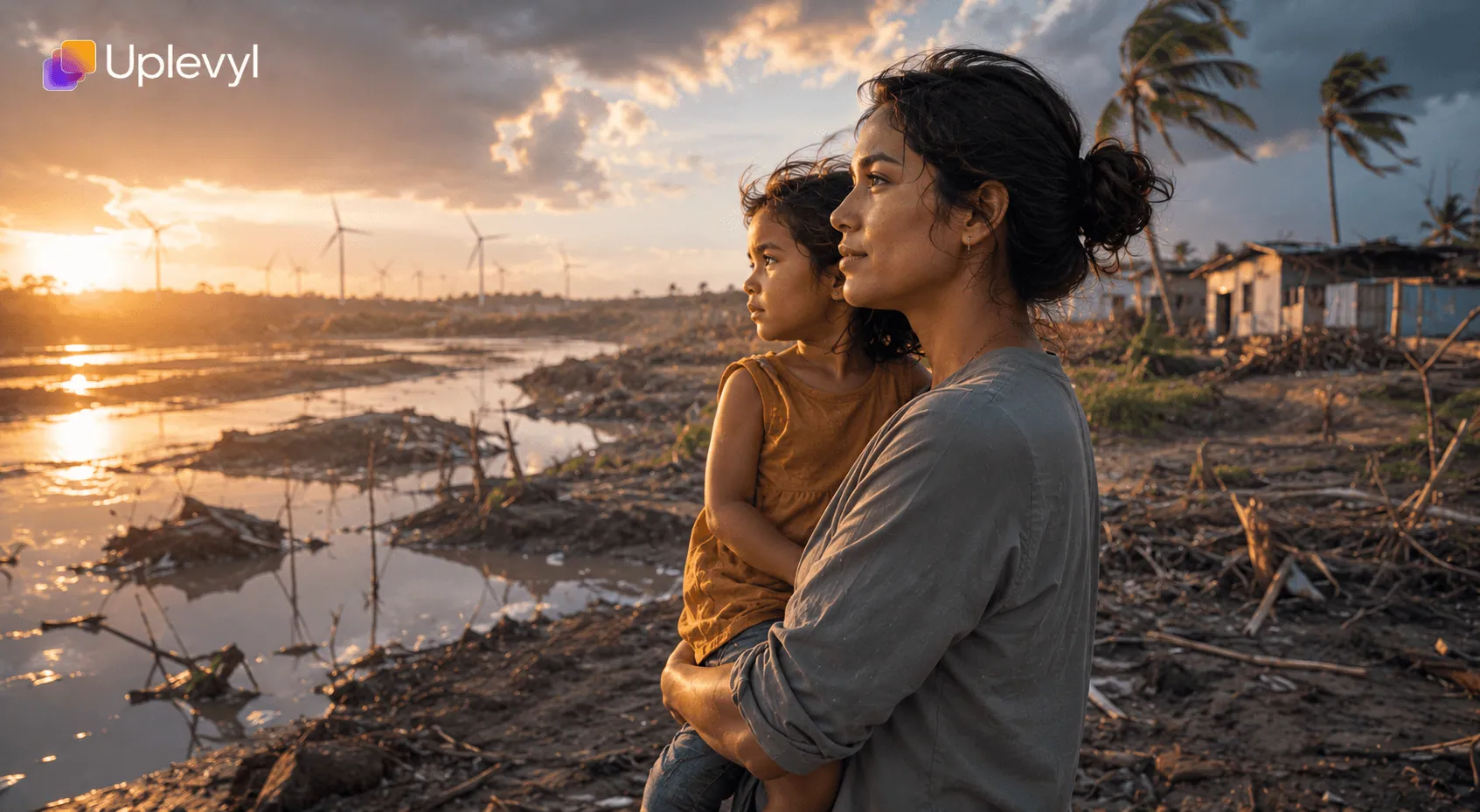
While climate change affects all people, its impact is not evenly distributed. In many parts of the world, women face disproportionate risks due to existing economic roles, caregiving responsibilities, and reduced access to resources during crises.
2. What Do the Numbers Reveal About Climate and Women?
The statistics are striking:
- In climate-vulnerable regions, women make up 70% of the agricultural workforce but control less than 20% of land.
- 80% of people displaced by climate-related disasters are women and girls (UN).
- Women are often the last to regain financial stability after droughts or extreme weather events.
Beyond economics, displacement shelters also expose women to heightened safety risks, while caregiving responsibilities often keep them in harm’s way during evacuations.
3. Why Was the July 2025 Court Ruling a Turning Point?
In July 2025, the International Court of Justice (ICJ) issued an advisory opinion confirming that countries can be held legally responsible for climate damages. While not binding, this ruling provides momentum for climate accountability worldwide.
For women-led organizations, this legal recognition creates a new framework to strengthen advocacy and hold governments accountable.
4. How Can Technology Help or Harm Climate Solutions?
When Tech Gets It Right:
- Real-time deforestation monitoring protects local communities.
- Flood prediction systems enable early evacuation.
- Pollution mapping exposes health risks at the neighborhood level.
When Tech Falls Short:
- Algorithms may overlook caregiver households who cannot evacuate.
- Data models that ignore women’s realities risk misallocating aid and resources.
The outcome depends on how technology is designed — whether it accounts for lived realities or assumes a “one-size-fits-all” approach.
5. Who Are the Women Driving Climate Action Globally?
Across the globe, women are leading climate solutions:
- Project Dandelion connects activists worldwide to push for systemic solutions.
- Asian-Pacific Forum on Women, Law and Development in Thailand combines legal advocacy with grassroots organizing.
- WECAN (Women’s Earth and Climate Action Network) builds alliances to defend forests, Indigenous rights, and community resilience.
These leaders are not only fighting climate threats but also building fairer, more resilient systems.
6. What Are the Most Promising Tech Solutions for the Future?
Some of the most impactful applications of AI and technology for climate action include:
- Smarter disaster preparedness using data that highlights at-risk households.
- Blockchain systems to secure land rights for smallholder farmers.
- Encrypted digital platforms that connect women leaders across borders.
- Low-tech solutions like SMS-based alerts and community radio for rural areas.
Not every solution requires high-end AI; often, simple and accessible tools make the biggest difference.
7. What Path Forward Can Accelerate Climate Action?
The ICJ ruling reminds us that climate harm is now a matter of accountability, not just awareness. For technology to become a lifeline, it must be:
- Co-created with frontline communities, not built for them in isolation.
- Based on accurate, disaggregated data that reflects real experiences.
- Safe by design, protecting defenders from harassment and surveillance.
- Tested in real-world conditions to ensure usability and effectiveness.
The question isn’t whether women can lead climate action — they already are. The real question is whether the tools they need will accelerate their impact or create new barriers.
The climate crisis is here. The time to design inclusive, effective solutions is now.
8. FAQs
1. Why does climate change affect women differently than men?
Climate change impacts everyone, but not equally. In many regions, women are more vulnerable due to caregiving responsibilities, limited access to land or financial resources, and roles in sectors like agriculture that are highly exposed to climate disruption. These structural inequalities make women disproportionately affected by extreme weather, food insecurity, and displacement.
2. What do the statistics show about women and climate vulnerability?
Global data reveals sharp disparities:
-
Women comprise 70% of the agricultural workforce in vulnerable regions but own less than 20% of land.
-
80% of people displaced by climate disasters are women and girls (UN).
-
After extreme weather events, women are the last to recover financially.
This imbalance highlights the urgent need for gender-informed climate policies and recovery frameworks.
3. What was the significance of the July 2025 International Court of Justice (ICJ) ruling?
The ICJ’s July 2025 advisory opinion confirmed that countries can be held legally accountable for climate-related harm. While non-binding, it establishes a critical precedent for global climate justice. For women-led organizations, this ruling strengthens advocacy efforts and opens pathways to hold governments accountable for gendered climate impacts.
4. How can technology both help and harm climate solutions?
Technology can be a powerful ally — or a source of inequity:
-
Positive examples: Early warning systems, pollution mapping, and blockchain land registries protect vulnerable communities.
-
Risks: Algorithms that overlook caregiver households or biased data that ignores women’s realities can worsen inequality.
The key is inclusive tech design that integrates real-world gender data and community input.
5. Who are the women leading global climate action today?
Across continents, women are shaping the climate movement:
-
Project Dandelion links global activists for systemic reform.
-
Asian-Pacific Forum on Women, Law and Development (APWLD) combines legal advocacy and grassroots mobilization.
-
WECAN (Women’s Earth and Climate Action Network) defends forests, Indigenous rights, and community resilience.
These leaders demonstrate how women’s networks drive equitable and sustainable change worldwide.
6. What technologies show the most promise for inclusive climate action?
Promising innovations include:
-
AI-driven disaster prediction that accounts for household caregiving patterns.
-
Blockchain-based land rights systems for smallholder farmers.
-
Encrypted digital hubs that connect women advocates globally.
-
Low-tech tools like SMS alerts and community radio that reach remote areas.
The future of climate tech lies in accessibility and representation — not just sophistication.