
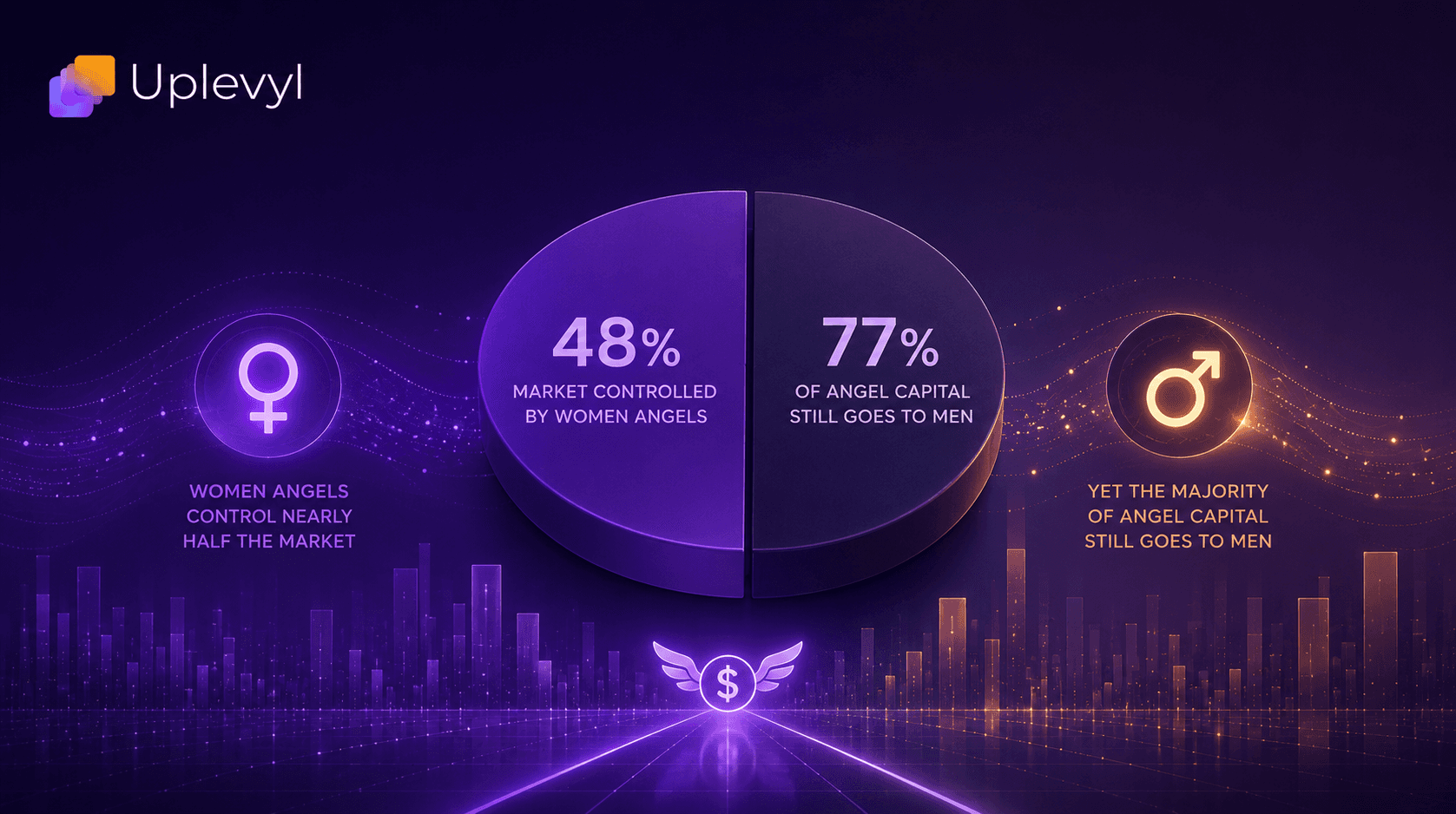
Women Angels Control Nearly Half the Market. So Why Does 77% of Angel Capital Still Go to Men?
Table of Contents
What Is The Real Bottleneck In Startup Funding For Women?
How Much Angel Capital Do Women Actually Control?
Why Does Most Angel Funding Still Go To Male Founders?
Are Women-Founded Startups Actually Less Investable?
What Structural Forces Influence Women Angel Investors?
Why Is Reallocating Angel Capital The Highest-Leverage Intervention?
What Would Happen If Women Angels Shifted Their Allocation?
FAQs
What Is the Real Bottleneck in Startup Funding for Women?
The venture capital statistic dominates headlines: women receive roughly 2% of VC funding.
But venture capital is downstream capital.
Before a company ever sees firms like Sequoia Capital or Andreessen Horowitz, it must survive the earliest phase of funding — the angel round.
And this is where trajectories are set.
Only about one in three seed-funded startups ever raise a Series A. For the 2022 cohort, that number dropped to roughly 15% (PitchBook) . Research shows that angel involvement significantly increases a startup’s probability of follow-on funding and successful exit.
The angel round is not optional. It is the survival gate.
How Much Angel Capital Do Women Actually Control?
According to the Center for Venture Research, women now represent approximately 46–47% of active angel investors and deploy nearly half of angel capital in the U.S.
This is a profound shift from a decade ago.
Women are no longer marginal participants in early-stage investing. They are capital allocators at scale.
Yet control of capital has not translated into proportional funding outcomes for women founders.
Why Does Most Angel Funding Still Go to Male Founders?
Portfolio allocation data compiled by Founders Forum Group and related angel surveys shows:
Female angels allocate roughly 35% of their investments to women founders
Male angels allocate about 13% to women founders
If we model a $100 angel market:
Women deploy $47
Men deploy $53
After allocation patterns are applied:
~$23 goes to women founders
~$77 goes to male founders
Even with near parity among investors, nearly three-quarters of angel capital still flows to male founders.
Women angel investors allocate 65% of their capital to male founders.
The widely celebrated statistic — that women angels fund women at higher rates than men do — obscures a harder truth:
Women angel investors still allocate 65% of their capital to male founders.
Are Women-Founded Startups Actually Less Investable?
The performance data suggests the opposite.
Boston Consulting Group found that women-founded startups generate 78 cents in revenue per dollar invested, compared to 31 cents for male-founded startups.
That is more than 2x the capital efficiency.
Additionally, PitchBook reported 13 women-founded unicorns minted in 2024 alone.
The issue is not performance. It is capital direction.
What Structural Forces Influence Women Angel Investors?
Three forces appear to shape allocation behavior:
A. Pattern matching and credibility heuristics
Angel investing is heavily influenced by prior founder archetypes and perceived signals of scale. These heuristics often reflect historically male-dominated founder models.
B. Network-driven deal flow
Angel investing is relationship-based. If pitch events, syndicates, and referral networks skew male, allocation outcomes will reflect that tilt.
C. Internalized ecosystem norms
Research in social psychology shows that marginalized groups can internalize dominant standards of credibility. Representation alone does not automatically correct bias.
The outcome is not necessarily intentional discrimination. It is systemic reinforcement.
Why Is Reallocating Angel Capital the Highest-Leverage Intervention?
By the time startups reach institutional venture rounds, narrative and traction are already established.
In 2024:
Women-only founding teams received just 1–2% of total VC funding
Only 20.5% of first financings went to women-led startups, down from 26.5% in 2020
The narrowing happens upstream.
The angel round determines who:
Builds an MVP
Hires early talent
Demonstrates product-market fit
Enters venture capital pipelines
Changing allocation at this stage alters the entire downstream funnel.
What Would Happen If Women Angels Shifted Allocation?
If women angels increased allocation to women founders from 35% to 50%, total angel capital flowing to women founders would rise from roughly 23% to over 30% — without requiring any behavioral change from male investors.
This is not a symbolic shift. It is structural leverage.
The capital is already in women’s hands. The opportunity lies in directional change.
FAQs
What percentage of angel investors are women?
Women represent approximately 46–47% of active angel investors in the United States .
How much angel funding goes to women founders?
Roughly 23% of modeled angel capital flows to women founders, meaning approximately 77% still goes to male founders .
Do women angel investors fund women founders at higher rates?
Yes. Women angels allocate about 35% of their portfolios to women founders, compared to roughly 13% for male angels . However, women angels still direct the majority of their capital to male founders.
Are women-founded startups less profitable?
No. Research shows women-founded startups generate more revenue per dollar invested than male-founded startups .
Why does early-stage funding matter more than venture capital headlines?
Because only a small fraction of seed-funded startups reach Series A . Angel capital determines which founders survive long enough to enter venture pipelines.
SOURCES
Jeffrey Sohl, “The Angel Market in 2023: An Inflection Point for Women Angels?”, Center for Venture Research, June 20, 2024.
Founders Forum Group, “Women in VC & Startup Funding: Statistics & Trends (2025 Report)”, Founders Forum Group, May 23, 2025.
Katie Abouzahr, Matt Krentz, John Harthorne, and Frances Brooks Taplett, “Why Women-Owned Startups Are a Better Bet”, Boston Consulting Group, June 6, 2018.
Peter Walker, Kevin Dowd, and Michael Young, PhD, “VC Fund Performance: Q1 2024”, Carta, August 16, 2024.
Annalisa Croce, Massimiliano Guerini, and Elisa Ughetto, “Angel financing and the performance of high-tech start-ups”, Journal of Small Business Management, vol. 56, no. 2, pp. 208–228, April 2018.
PitchBook Data, Inc., “2024 US all in: female founders in the VC ecosystem”, PitchBook, March 4, 2025.
Women Angels Control Nearly Half the Market. So Why Does 77% of Angel Capital Still Go to Men?
Table of Contents
What Is The Real Bottleneck In Startup Funding For Women?
How Much Angel Capital Do Women Actually Control?
Why Does Most Angel Funding Still Go To Male Founders?
Are Women-Founded Startups Actually Less Investable?
What Structural Forces Influence Women Angel Investors?
Why Is Reallocating Angel Capital The Highest-Leverage Intervention?
What Would Happen If Women Angels Shifted Their Allocation?
FAQs
What Is the Real Bottleneck in Startup Funding for Women?
The venture capital statistic dominates headlines: women receive roughly 2% of VC funding.
But venture capital is downstream capital.
Before a company ever sees firms like Sequoia Capital or Andreessen Horowitz, it must survive the earliest phase of funding — the angel round.
And this is where trajectories are set.
Only about one in three seed-funded startups ever raise a Series A. For the 2022 cohort, that number dropped to roughly 15% (PitchBook) . Research shows that angel involvement significantly increases a startup’s probability of follow-on funding and successful exit.
The angel round is not optional. It is the survival gate.
How Much Angel Capital Do Women Actually Control?
According to the Center for Venture Research, women now represent approximately 46–47% of active angel investors and deploy nearly half of angel capital in the U.S.
This is a profound shift from a decade ago.
Women are no longer marginal participants in early-stage investing. They are capital allocators at scale.
Yet control of capital has not translated into proportional funding outcomes for women founders.
Why Does Most Angel Funding Still Go to Male Founders?
Portfolio allocation data compiled by Founders Forum Group and related angel surveys shows:
Female angels allocate roughly 35% of their investments to women founders
Male angels allocate about 13% to women founders
If we model a $100 angel market:
Women deploy $47
Men deploy $53
After allocation patterns are applied:
~$23 goes to women founders
~$77 goes to male founders
Even with near parity among investors, nearly three-quarters of angel capital still flows to male founders.
Women angel investors allocate 65% of their capital to male founders.
The widely celebrated statistic — that women angels fund women at higher rates than men do — obscures a harder truth:
Women angel investors still allocate 65% of their capital to male founders.
Are Women-Founded Startups Actually Less Investable?
The performance data suggests the opposite.
Boston Consulting Group found that women-founded startups generate 78 cents in revenue per dollar invested, compared to 31 cents for male-founded startups.
That is more than 2x the capital efficiency.
Additionally, PitchBook reported 13 women-founded unicorns minted in 2024 alone.
The issue is not performance. It is capital direction.
What Structural Forces Influence Women Angel Investors?
Three forces appear to shape allocation behavior:
A. Pattern matching and credibility heuristics
Angel investing is heavily influenced by prior founder archetypes and perceived signals of scale. These heuristics often reflect historically male-dominated founder models.
B. Network-driven deal flow
Angel investing is relationship-based. If pitch events, syndicates, and referral networks skew male, allocation outcomes will reflect that tilt.
C. Internalized ecosystem norms
Research in social psychology shows that marginalized groups can internalize dominant standards of credibility. Representation alone does not automatically correct bias.
The outcome is not necessarily intentional discrimination. It is systemic reinforcement.
Why Is Reallocating Angel Capital the Highest-Leverage Intervention?
By the time startups reach institutional venture rounds, narrative and traction are already established.
In 2024:
Women-only founding teams received just 1–2% of total VC funding
Only 20.5% of first financings went to women-led startups, down from 26.5% in 2020
The narrowing happens upstream.
The angel round determines who:
Builds an MVP
Hires early talent
Demonstrates product-market fit
Enters venture capital pipelines
Changing allocation at this stage alters the entire downstream funnel.
What Would Happen If Women Angels Shifted Allocation?
If women angels increased allocation to women founders from 35% to 50%, total angel capital flowing to women founders would rise from roughly 23% to over 30% — without requiring any behavioral change from male investors.
This is not a symbolic shift. It is structural leverage.
The capital is already in women’s hands. The opportunity lies in directional change.
FAQs
What percentage of angel investors are women?
Women represent approximately 46–47% of active angel investors in the United States .
How much angel funding goes to women founders?
Roughly 23% of modeled angel capital flows to women founders, meaning approximately 77% still goes to male founders .
Do women angel investors fund women founders at higher rates?
Yes. Women angels allocate about 35% of their portfolios to women founders, compared to roughly 13% for male angels . However, women angels still direct the majority of their capital to male founders.
Are women-founded startups less profitable?
No. Research shows women-founded startups generate more revenue per dollar invested than male-founded startups .
Why does early-stage funding matter more than venture capital headlines?
Because only a small fraction of seed-funded startups reach Series A . Angel capital determines which founders survive long enough to enter venture pipelines.
SOURCES
Jeffrey Sohl, “The Angel Market in 2023: An Inflection Point for Women Angels?”, Center for Venture Research, June 20, 2024.
Founders Forum Group, “Women in VC & Startup Funding: Statistics & Trends (2025 Report)”, Founders Forum Group, May 23, 2025.
Katie Abouzahr, Matt Krentz, John Harthorne, and Frances Brooks Taplett, “Why Women-Owned Startups Are a Better Bet”, Boston Consulting Group, June 6, 2018.
Peter Walker, Kevin Dowd, and Michael Young, PhD, “VC Fund Performance: Q1 2024”, Carta, August 16, 2024.
Annalisa Croce, Massimiliano Guerini, and Elisa Ughetto, “Angel financing and the performance of high-tech start-ups”, Journal of Small Business Management, vol. 56, no. 2, pp. 208–228, April 2018.
PitchBook Data, Inc., “2024 US all in: female founders in the VC ecosystem”, PitchBook, March 4, 2025.