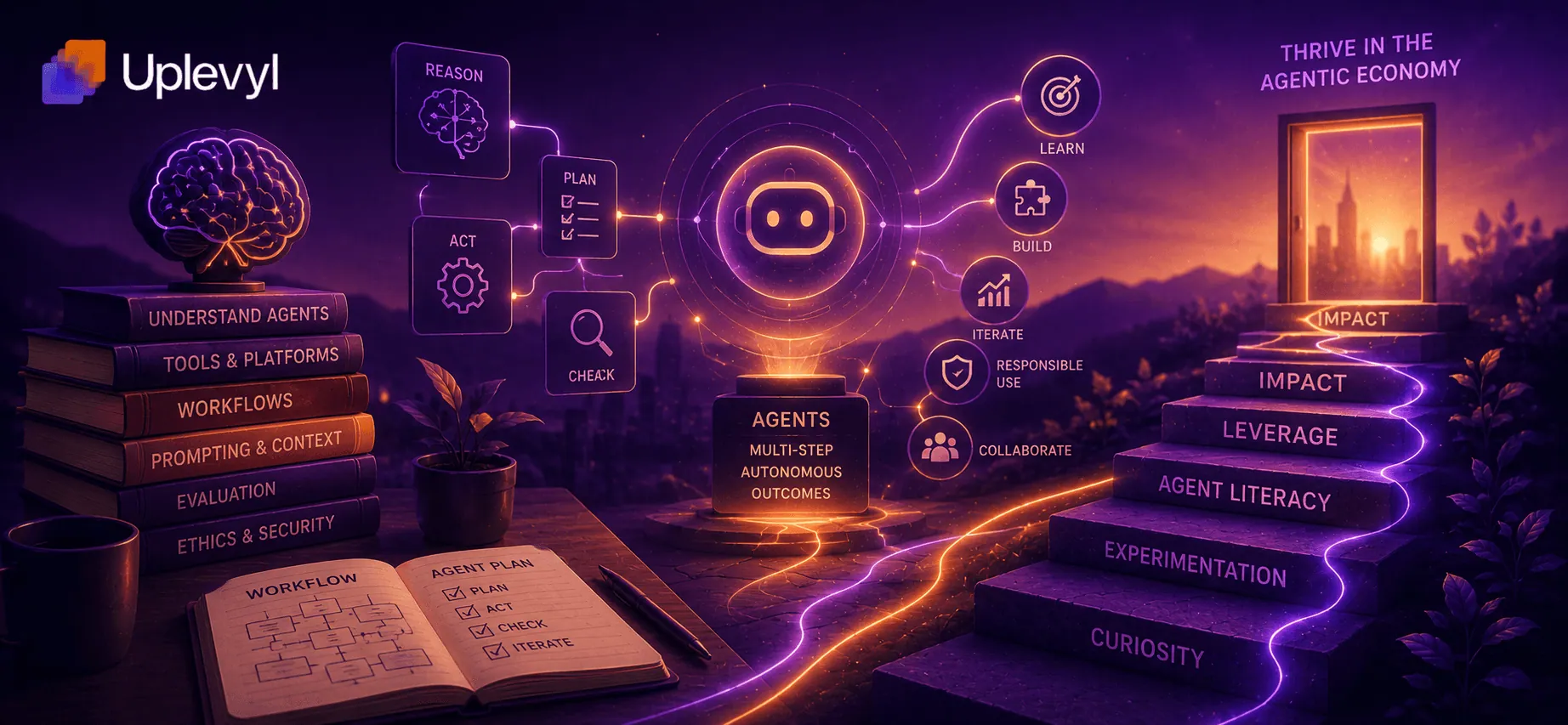
Reading about agents is not enough. You have to build one. Here is exactly how to start.
By Shubhi Rao, Founder & CEO, Uplevyl
Every week I talk to smart, capable professionals who are watching the agentic economy arrive and doing the same thing: waiting to feel ready.
Some are reading articles. Some are taking courses. Some are telling themselves they will start experimenting once things settle down. Things are not going to settle down. And reading about agents is not the same as building one.
You are not going to develop agent fluency by reading about agents. You have to build one.
This is the single skill every one of us in the workforce is going to need. Just as an earlier generation had to learn Word, Excel, PowerPoint, and email as baseline professional competencies, the baseline of the next decade will be understanding agents and workflows at a functional level. Not as an engineer. As a professional who directs, evaluates, and deploys them.
In my last piece, I wrote about the WHAT of the agentic economy: which jobs are most exposed, what is being lost when the training layer disappears, and what skills will matter. The question I heard back most often was simple: that is all well and good, but how do I actually start?
"Learn AI" is not the answer. "Take an online course" is not sufficient. "Experiment with ChatGPT" is a start, but it is not the same as building agent literacy. Here is how to actually get there.
Most people confuse tools with agents. Here is the difference that actually matters.
A traditional AI tool responds to a single prompt. You ask, it answers. The interaction ends. That is a chatbot, not an agent.
An agent is different in one critical way: it takes a sequence of actions across multiple steps, tools, and decisions to complete a goal. It does not just respond. It reasons, plans, executes, checks its own output, and continues until the task is done.
Think of it this way. Asking Claude or ChatGPT to summarize an email is using a tool. Building a workflow where Claude monitors your inbox, identifies emails that need a response, drafts the reply, checks it against your tone guidelines, and flags it for your approval is deploying an agent.
One answers a question. The other manages a process.
That distinction is not semantic. It changes what you need to know, what you need to build, and where the real value lies.
The agent landscape is moving fast. Here is how to orient yourself without drowning in it.
There are five categories worth understanding. Knowing which category an agent belongs to tells you immediately what it is designed to do, what its limitations are, and whether it belongs in your workflow.
- Coding agents like Cursor and GitHub Copilot Workspace function as active programming partners, writing code, reviewing it, identifying bugs, and iterating on fixes. These are among the most mature agents in the market.
- Research and browsing agents like Perplexity Computer and OpenAI's Operator can browse the web, gather information across multiple sources, synthesize findings, and produce structured outputs, all without you issuing a new prompt at each step.
- Workflow automation agents like those built with Notion, n8n, or Zapier connect your existing tools and apps, triggering actions in one system based on events in another. These are the most accessible entry point for non-technical professionals.
- Personal task agents like Claude with Projects can hold ongoing context about your work, your preferences, and your goals, and handle multi-step tasks on your behalf over time.
- Domain-specific agents are emerging in legal, finance, healthcare, HR, and sales, trained on specialized knowledge and integrated with the tools of a specific industry. Uplevyl's UpGenie, for example, is trained on gender-focused specialized knowledge.
You do not need to follow everything. You need to follow the right things.
New agents are shipping every week. You do not need to evaluate each one, but you do need a habit of staying informed in your own domain.
Subscribe to one or two newsletters that track agent launches specifically, not AI broadly. The Upside, which I plan to publish weekly, covers the five most consequential agent launches each week with plain-English explanations and difficulty ratings so you know immediately whether something is relevant to you. Other useful sources include The Rundown AI, Neuron and Ben's Bites for general coverage, and domain-specific Substack writers for your industry.
Set a standing search alert for your job function plus the word agent. Marketing agent. HR agent. Finance agent. Operations agent. Go to LinkedIn, type your search, click Posts, and save it. What shows up in six months will be very different from what shows up today. The gap between those two moments is exactly the window in which you want to be building familiarity, not catching up.
The step everyone skips is the only one that actually works.
Reading about agents gives you vocabulary. Building one gives you judgment. Judgment is what the next economy will pay for.
You do not need to be a developer. You do not need to know how to code. The tools available today, particularly Claude, Notion, and Zapier or n8n, are accessible enough that anyone willing to spend a few hours can build a functional workflow.
Let me show you exactly what that looks like in practice.
A real workflow anyone can build this week, including the security architecture
My husband and I wanted to automate some of the mundane and time consuming activities we all deal with in running our lives. One of them is to scan our credit card bills for unusual charges or unwanted subscriptions. However, the obvious concern when you think about automating anything financial is security: you do not want sensitive account information flowing through third-party systems.
Here is exactly how I helped him build it in a secure way:
- Step 1: Export, do not connect. He downloaded a CSV transaction export from our issuing bank's website. This is a standard feature on most banking platforms. Critically, this CSV contains transaction descriptions and amounts only. It does not contain account numbers, card numbers, routing information, or login credentials. The export lives on his local computer and goes nowhere near any external system.
- Step 2: Strip any identifying details. Before doing anything with the file, we did a quick scan to confirm there is nothing in the export we would not want to share. Most bank exports are clean in this regard, but it takes thirty seconds to check.
- Step 3: Write a standing prompt in Claude. I had him click on Projects on the ribbon on the left and create a project called “Credit Card Monitory”. Projects are a feature in Claude that let you store instructions, context, and files that persist across every conversation. He wrote a simple prompt that defines what counts as unusual for our household: charges over a certain amount that we have not seen before, unfamiliar merchant names, duplicate charges within a short window, and subscriptions we may have forgotten about. Now this becomes a standing prompt in as the Project Instructions, and then every time he opens that Project and pastes in the new CSV, Claude already knows the rules without you having to re-explain them. The prompt lives there permanently until he changes it.
- Step 4: Paste and review. He pasted the transaction data into Claude along with the standing prompt. Claude scanned the list, flagged anything that met the criteria, and produced a short summary with its reasoning. The whole process took about four minutes.
What he built was a simple but genuine agent workflow: a repeatable process with defined inputs, a reasoning layer, and a structured output. No code. No subscription beyond a basic Claude account. No sensitive data leaving our home network. We had just created a digital bookkeeper. Claude never sees your account. It only sees the same transaction list you would show a human bookkeeper.
This is an example template. The specific workflow does not matter. What matters is that you have built something, tested it, found its edges, improved it, and now understand at a functional level how agents work in practice.
The cognitive shift the agentic economy is demanding, and why most people are not prepared for it
Think about what it meant, in 1995, to know how to use Microsoft Office.
You did not need to understand how the software was built. You needed to open a document, format it, save it, share it. The cognitive demand was execution: someone defined the task and the process, and you performed it. The spreadsheet was the tool that helped you do it faster and more accurately.
The shift happening now is more fundamental than a new tool requiring a new skill. It is a shift in the type of thinking the job requires.
For most of the modern workforce, the dominant cognitive mode has been execution thinking: here is the task, here is the process, do it well. A layer above that sits strategic thinking: decide what to do, set direction, allocate resources. What the agentic economy is doing is creating urgent demand for a third mode that most people have rarely needed to develop formally.
Call it process thinking. When an agent does the execution, your job is no longer to perform the steps. It is to design them.
What is the goal? What are the inputs? In what sequence do things happen? What does good output look like? Where could this break down and why? That is a different cognitive function entirely. It is the thinking of a systems designer, not a task performer.
Until now, process thinking was the job of a small group: the operations lead, the workflow architect, the person who designed the job everyone else followed. The agentic economy is pushing it down to the individual contributor level, asking every professional to think like the person who used to design their role.
That is the new baseline. Not knowing how to operate a tool. Knowing how to design the workflow the tool runs inside. Within the next two to three years, being able to define a process, write a clear instruction to an agent, evaluate its output, and iterate on the design will be as expected as knowing how to use a spreadsheet.
Where to start this week
Most people will read this article and do nothing.
Not because they do not want to. Because "start building agents" feels overwhelming and abstract. So here is the most specific possible version of where to begin. Four steps. Two weeks. No technical background required.
- Step 1: Map before you build. Pick one task you do on repeat. Not your most complex one. The boring one. The one you could do in your sleep. Write every single step down as if you were explaining it to a new hire on their first day. Do not open any AI tool yet.
Here is what will happen: you will get vague. You will write "then I figure out the exceptions" or "then I just know what to do next." Circle every one of those moments. That vagueness is not a flaw in your writing. It is the exact gap between human intuition and what an agent needs to execute. You just did your first process audit.
- Step 2: Let the AI interrogate your process. Open ChatGPT or Claude. Paste in your steps. Ask it one question: "If you were going to automate this workflow, what would you need me to define more precisely?"
Read what it asks you. Most people find this uncomfortable. The AI will surface assumptions you did not know you were making. That discomfort is the learning. This is process thinking in practice.
- Step 3: Write your first real prompt. Take everything Step 2 revealed and rewrite your steps. Make them precise enough that an agent could follow them without asking you a single clarifying question. This is your first prompt draft. It will not be perfect. It does not need to be.
- Step 4: Test it on something real. Take that prompt into Claude and run it against actual data from your work or personal life. See what it gets right. See what it misses. Ask yourself why. Iterate once.
You now have a working workflow. More importantly, you have firsthand experience of where process thinking breaks down in practice. No course teaches you that. Only building does.
What you are actually building
The goal is not to become a developer or understand the architecture of large language models.
The goal is to develop enough firsthand fluency with how agents work that you can direct them intelligently, spot their failure modes, evaluate their output critically, and design workflows that put them to good use in your domain.
That is a professional skill. It is learnable. It does not require a technical background. It requires curiosity, process thinking, a willingness to build messy first attempts, and the discipline to keep going.