
The Algorithm Has a Race Problem. And Black Mothers Are Paying for It.
Black Maternal Health Week runs April 11 through 17. The numbers deserve more than one week.
Table of Contents
How Does the Black Maternal Mortality Gap Break Down by the Numbers?
What Role Does Implicit Bias Play in Clinical Settings?
How Is Algorithmic Bias Accelerating the Crisis?
What Does Black Women-Led Innovation Look Like in Practice?
Why Does the Current Policy Direction Make This Worse?
What Does a Gender- and Race-Intelligent Healthcare System Actually Require?
FAQs
How Does the Black Maternal Mortality Gap Break Down by the Numbers?
According to the CDC's 2024 report, the maternal mortality rate for Black women was 44.8 deaths per 100,000 live births. For white women, it was 14.2. For Hispanic women, 12.1.
Black women in the US are three times more likely to die from pregnancy-related causes than white women. More than 80% of those deaths are considered preventable by the CDC itself.
McKinsey's 2025 analysis of the Black maternal health gap found that in 2023, 247 of the 669 total maternal deaths in the US were among Black women. They constitute roughly 15% of births in the US and roughly 37% of maternal deaths. The math is not complicated. The inaction is.
The disparity does not shrink as income rises. Research published in The Lancet in 2023 found that Black women in areas with greater access to maternal health care still die at disproportionately higher rates than white women in underserved areas. Access, in isolation, does not close the gap. The gap is structural, which means it requires structural intervention.
What Role Does Implicit Bias Play in Clinical Settings?
A 2023 study published in JAMA Network Open found that Black patients were 40% less likely than white patients to receive adequate pain management. That disparity extends directly into obstetric care. It is well documented that Black women's reports of pain are routinely discounted, that concerns about symptoms during pregnancy are more likely to be dismissed, and that the threshold for intervention is different depending on the patient's race.
Dr. LaTasha Seliby Perkins, assistant professor at Georgetown University School of Medicine, has spoken publicly about experiencing this herself during pregnancy: a doctor overlook the fact that she was of advanced maternal age, despite her medical training and her explicit flag of concern.
When providers do not take Black patients' self-reported symptoms seriously, clinical protocols cannot compensate. Implicit bias in medicine is not a marginal problem. It is the water.
Studies consistently show that Black patients have better outcomes when treated by Black physicians, partly because of higher trust and reduced under-treatment. Yet Black students are underrepresented in medical school pipelines, and the rates of Black students entering medicine have declined in recent years, precisely as the need for racially concordant care grows more documented.
How Is Algorithmic Bias Accelerating the Crisis?
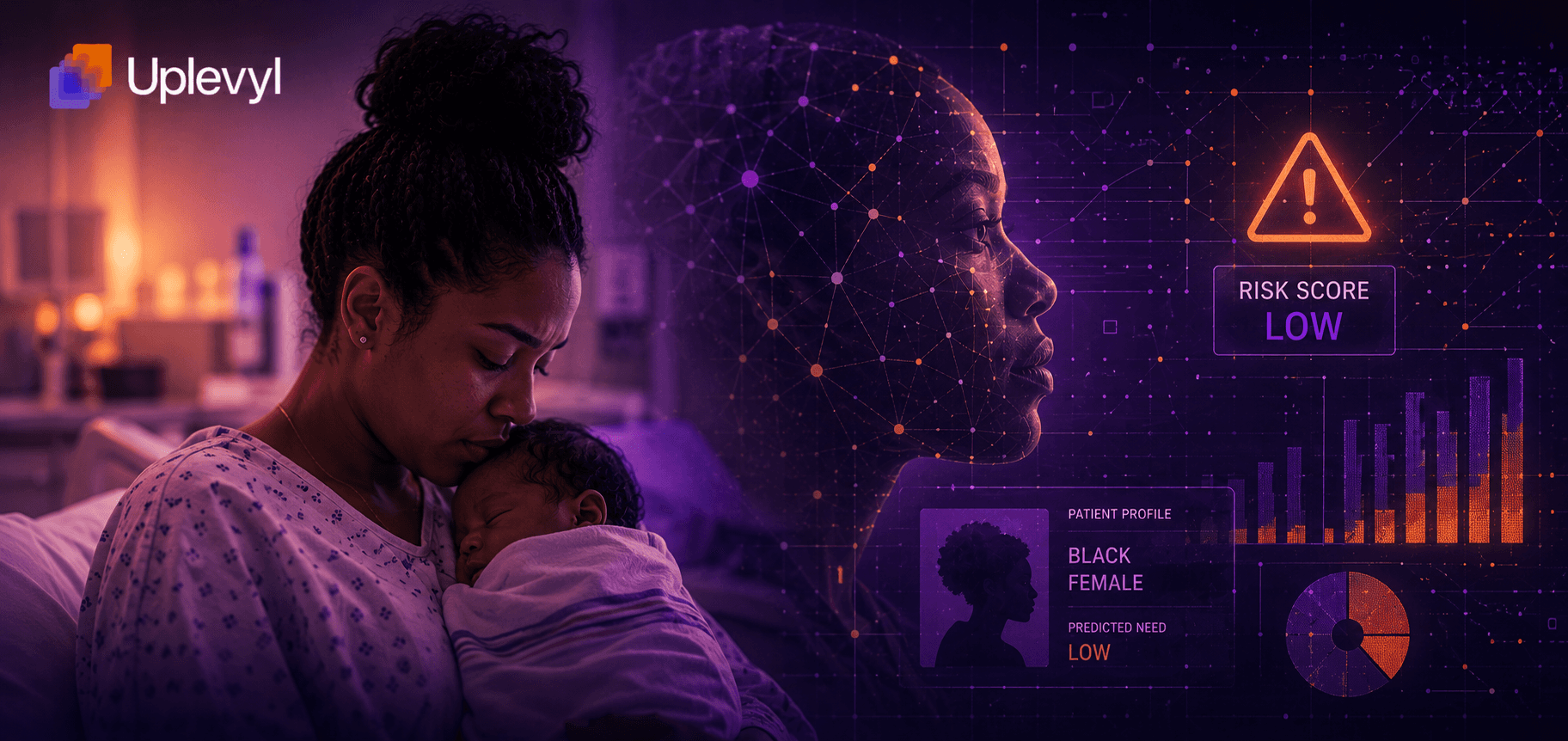
In 2019, a landmark study published in Science examined a commercial healthcare algorithm used across US hospitals to identify which patients needed high-risk care management. The algorithm affected more than 100 million patients. It was systematically biased against Black patients.
The mechanism was this: the algorithm used healthcare spending as a proxy for health needs. Because Black patients historically have less access to care and therefore spend less on it, the algorithm read lower spending as lower need. The result was that Black patients had to be measurably sicker than white patients to receive the same level of care management. Fixing the proxy, the researchers found, would have more than doubled the share of Black patients flagged for additional care.
The algorithm did not malfunction. It learned from data that reflected decades of unequal access. It then reproduced that inequality at scale, across hundreds of hospitals, invisibly.
This is not a historical problem. As hospitals increasingly adopt AI-powered clinical decision support tools to triage patients, assign risk scores, and recommend interventions, the same structural vulnerability applies. Predictive tools for preterm birth, hypertension risk, and postpartum hemorrhage have largely been built on clinical data skewed toward white, higher-income patient populations. When deployed across hospitals serving a more diverse patient population, the models underperform exactly where they are most needed.
Black Mamas Matter Alliance has named this directly: what they call Black Maternal Health Data Justice is the right of Black women to be accurately counted, included in research cohorts, and represented in the datasets used to train the tools that will shape their care. It is not a theoretical demand. It is the upstream intervention that makes everything else downstream more likely to work.
What Does Black Women-Led Innovation Look Like in Practice?
The practitioners building toward a different outcome are largely women, and often Black women who have experienced the system's failures firsthand or built their companies in direct response to them.
Mahmee, co-founded by Melissa Hanna, is a maternal and newborn care platform that uses AI to connect high-risk patients with coordinated care teams across providers. Their data shows a significant reduction in readmission rates and improved postpartum outcomes, particularly among Medicaid-enrolled patients. The platform has received backing from investors including Serena Williams and has been piloted at several major health systems. The design logic is different: rather than optimizing for cost efficiency, it optimizes for continuity of care for patients most likely to be missed by a fragmented system.
Oula Health was founded with a focus on full-spectrum midwifery care, bridging community-based care and clinical intervention for patients historically underserved in hospital settings. Its model integrates digital intake, remote monitoring, and continuity of care across the pregnancy-to-postpartum arc, the exact window where Black women are most at risk.
These platforms share a design premise that most legacy systems do not: the assumption that patients who are hardest to reach require the most sophisticated infrastructure, not the least.
This is not charity. It is the logic of building for the edge case, which in US maternal health means building for Black women, and finding that the result is a better system for everyone.
Why Does the Current Policy Direction Make This Worse?
In 2025, the federal government moved to cut over $11 billion in public health funding, including significant reductions to Medicaid, maternal health grants, and programs specifically designed to address racial disparities in birth outcomes.
The connection between Medicaid coverage and maternal outcomes is direct and documented. One of the factors credited with the partial decline in overall maternal mortality rates between 2022 and 2023 was the expansion of federal Medicaid coverage to include up to 12 months of postpartum care, rather than the previous six-week cutoff. Black women, who are disproportionately enrolled in Medicaid, disproportionately benefit from that coverage. Cutting it disproportionately harms them.
For states with the highest concentrations of Black maternal deaths, many of which are heavily dependent on federal support, these funding reductions translate directly into reduced access to prenatal care, reduced obstetric provider availability in rural and low-income areas, and reduced capacity for the community health worker programs that have shown measurable impact on Black maternal outcomes.
When a funding decision disproportionately removes resources from the population with the worst outcomes, the policy is not neutral. It is an intervention. The question is only in which direction.
What Does a Gender- and Race-Intelligent Healthcare System Actually Require?
Technology does not fix structural racism. This point is worth stating plainly before listing what technology can do. No algorithm closes a gap that clinical culture, provider bias, and decades of disinvestment created. But technology can shift who has access to information, who gets flagged for early intervention, and whose experience is centered in how care systems are designed.
A genuinely race- and gender-intelligent healthcare system requires several things that current systems consistently fail to provide:
Training data that includes representative samples of Black women across income levels, geographies, and clinical presentations, not just data from institutions that happen to have high rates of Black patient enrollment.
Algorithmic audit requirements that mandate disclosure of how tools perform across racial subgroups before deployment, not after harm has accumulated.
Obstetric risk tools built on outcome data rather than cost proxies, so that the algorithm's goal is aligned with the clinical goal of preventing death.
Community health worker integration into digital care pathways, so that the trust relationships and context that formal clinical settings often lack are built into the system.
Postpartum monitoring tools that extend coverage to match the full window of risk, the majority of pregnancy-related deaths occur in the postpartum period, often after clinical contact has ended.
Black Mamas Matter Alliance's call for data justice is the organizing principle that ties these together. It is not enough to build better tools. The data those tools are trained on must reflect the lives of the women the tools are supposed to protect.
FAQs
What Is the Black Maternal Mortality Gap and How Large Is It?
According to the CDC's 2024 data, Black women in the United States die from pregnancy-related causes at a rate of 44.8 deaths per 100,000 live births, compared to 14.2 for white women. This means Black women are roughly three times more likely to die from a pregnancy-related cause. More than 80% of these deaths are considered preventable by the CDC.
Does Higher Income or Education Close the Gap for Black Women?
Research consistently shows it does not. A 2023 study in The Lancet found that Black women in areas with greater access to maternal health care still die at disproportionately higher rates than white women in underserved areas. The disparity is rooted in structural factors including clinical bias, algorithmic underestimation of health needs, and systemic disinvestment, not individual behavior or resources.
How Does Algorithmic Bias Affect Black Maternal Health Specifically?
Predictive tools used in obstetric care for preterm birth risk, hypertension, and postpartum hemorrhage have largely been trained on data skewed toward white, higher-income patient populations. When deployed across more diverse hospital populations, these tools underperform for Black women. The 2019 Science study on healthcare algorithms demonstrated this mechanism clearly: cost-based proxies underestimate need for patients who have historically had less access to care.
What Has Black Women-Led Innovation Produced in This Space?
Platforms like Mahmee and Oula Health were designed specifically around the gaps in standard obstetric care. Mahmee's AI-connected care teams have shown reduced readmission rates particularly among Medicaid-enrolled patients. Both platforms operate from the premise that patients most likely to be missed by a fragmented system require the most intentional infrastructure, not the least.
What Would a Structural Fix Actually Require?
Structural change requires representative training data, algorithmic audit requirements before deployment, obstetric risk tools built on outcome data rather than cost proxies, community health worker integration into digital care pathways, and extended postpartum monitoring. Black Mamas Matter Alliance's framework of Data Justice provides the organizing principle: better tools are only part of the solution if the data those tools learn from does not reflect the lives of the women they are supposed to protect.
About Uplevyl
Uplevyl is an AI-driven platform built at the intersection of gender equity and professional advancement for women. We build gender-intelligent systems and content ecosystems that center women's lived realities, including the realities of Black women navigating institutions that have consistently undercounted and underserved them.
Sources
CDC, Maternal Mortality Rates in the United States, 2024 — https://www.cdc.gov/nchs/data/hestat/hestat113.htm
McKinsey, Closing the Black Maternal Health Gap — https://www.mckinsey.com/institute-for-economic-mobility/our-insights/closing-the-black-maternal-health-gap-healthier-lives-stronger-economies
Commonwealth Fund, Insights into the US Maternal Mortality Crisis — https://www.commonwealthfund.org/publications/issue-briefs/2024/jun/insights-us-maternal-mortality-crisis-international-comparison
JAMA Network Open, 2023 study on pain management disparities — https://jamanetwork.com/journals/jamanetworkopen/fullarticle/2810768
Obermeyer et al., Dissecting racial bias in an algorithm used to manage the health of populations, Science, 2019 — https://www.science.org/doi/10.1126/science.aax2342
The Lancet, 2023 study on Black women in areas with greater care access — https://www.thelancet.com (I do not have a direct verified URL for this specific Lancet citation and recommend you verify it before publishing rather than linking a dead or incorrect URL)
Black Mamas Matter Alliance — https://blackmamasmatter.org
Mahmee — https://www.mahmee.com
Oula Health — https://oulahealth.com
PBS NewsHour, federal public health funding cuts, 2025 — https://www.pbs.org/newshour/health/trump-administrations-deep-cuts-to-public-health-leave-system-reeling
The Algorithm Has a Race Problem. And Black Mothers Are Paying for It.
Black Maternal Health Week runs April 11 through 17. The numbers deserve more than one week.
Table of Contents
How Does the Black Maternal Mortality Gap Break Down by the Numbers?
What Role Does Implicit Bias Play in Clinical Settings?
How Is Algorithmic Bias Accelerating the Crisis?
What Does Black Women-Led Innovation Look Like in Practice?
Why Does the Current Policy Direction Make This Worse?
What Does a Gender- and Race-Intelligent Healthcare System Actually Require?
FAQs
How Does the Black Maternal Mortality Gap Break Down by the Numbers?
According to the CDC's 2024 report, the maternal mortality rate for Black women was 44.8 deaths per 100,000 live births. For white women, it was 14.2. For Hispanic women, 12.1.
Black women in the US are three times more likely to die from pregnancy-related causes than white women. More than 80% of those deaths are considered preventable by the CDC itself.
McKinsey's 2025 analysis of the Black maternal health gap found that in 2023, 247 of the 669 total maternal deaths in the US were among Black women. They constitute roughly 15% of births in the US and roughly 37% of maternal deaths. The math is not complicated. The inaction is.
The disparity does not shrink as income rises. Research published in The Lancet in 2023 found that Black women in areas with greater access to maternal health care still die at disproportionately higher rates than white women in underserved areas. Access, in isolation, does not close the gap. The gap is structural, which means it requires structural intervention.
What Role Does Implicit Bias Play in Clinical Settings?
A 2023 study published in JAMA Network Open found that Black patients were 40% less likely than white patients to receive adequate pain management. That disparity extends directly into obstetric care. It is well documented that Black women's reports of pain are routinely discounted, that concerns about symptoms during pregnancy are more likely to be dismissed, and that the threshold for intervention is different depending on the patient's race.
Dr. LaTasha Seliby Perkins, assistant professor at Georgetown University School of Medicine, has spoken publicly about experiencing this herself during pregnancy: a doctor overlook the fact that she was of advanced maternal age, despite her medical training and her explicit flag of concern.
When providers do not take Black patients' self-reported symptoms seriously, clinical protocols cannot compensate. Implicit bias in medicine is not a marginal problem. It is the water.
Studies consistently show that Black patients have better outcomes when treated by Black physicians, partly because of higher trust and reduced under-treatment. Yet Black students are underrepresented in medical school pipelines, and the rates of Black students entering medicine have declined in recent years, precisely as the need for racially concordant care grows more documented.
How Is Algorithmic Bias Accelerating the Crisis?
In 2019, a landmark study published in Science examined a commercial healthcare algorithm used across US hospitals to identify which patients needed high-risk care management. The algorithm affected more than 100 million patients. It was systematically biased against Black patients.
The mechanism was this: the algorithm used healthcare spending as a proxy for health needs. Because Black patients historically have less access to care and therefore spend less on it, the algorithm read lower spending as lower need. The result was that Black patients had to be measurably sicker than white patients to receive the same level of care management. Fixing the proxy, the researchers found, would have more than doubled the share of Black patients flagged for additional care.
The algorithm did not malfunction. It learned from data that reflected decades of unequal access. It then reproduced that inequality at scale, across hundreds of hospitals, invisibly.
This is not a historical problem. As hospitals increasingly adopt AI-powered clinical decision support tools to triage patients, assign risk scores, and recommend interventions, the same structural vulnerability applies. Predictive tools for preterm birth, hypertension risk, and postpartum hemorrhage have largely been built on clinical data skewed toward white, higher-income patient populations. When deployed across hospitals serving a more diverse patient population, the models underperform exactly where they are most needed.
Black Mamas Matter Alliance has named this directly: what they call Black Maternal Health Data Justice is the right of Black women to be accurately counted, included in research cohorts, and represented in the datasets used to train the tools that will shape their care. It is not a theoretical demand. It is the upstream intervention that makes everything else downstream more likely to work.
What Does Black Women-Led Innovation Look Like in Practice?
The practitioners building toward a different outcome are largely women, and often Black women who have experienced the system's failures firsthand or built their companies in direct response to them.
Mahmee, co-founded by Melissa Hanna, is a maternal and newborn care platform that uses AI to connect high-risk patients with coordinated care teams across providers. Their data shows a significant reduction in readmission rates and improved postpartum outcomes, particularly among Medicaid-enrolled patients. The platform has received backing from investors including Serena Williams and has been piloted at several major health systems. The design logic is different: rather than optimizing for cost efficiency, it optimizes for continuity of care for patients most likely to be missed by a fragmented system.
Oula Health was founded with a focus on full-spectrum midwifery care, bridging community-based care and clinical intervention for patients historically underserved in hospital settings. Its model integrates digital intake, remote monitoring, and continuity of care across the pregnancy-to-postpartum arc, the exact window where Black women are most at risk.
These platforms share a design premise that most legacy systems do not: the assumption that patients who are hardest to reach require the most sophisticated infrastructure, not the least.
This is not charity. It is the logic of building for the edge case, which in US maternal health means building for Black women, and finding that the result is a better system for everyone.
Why Does the Current Policy Direction Make This Worse?
In 2025, the federal government moved to cut over $11 billion in public health funding, including significant reductions to Medicaid, maternal health grants, and programs specifically designed to address racial disparities in birth outcomes.
The connection between Medicaid coverage and maternal outcomes is direct and documented. One of the factors credited with the partial decline in overall maternal mortality rates between 2022 and 2023 was the expansion of federal Medicaid coverage to include up to 12 months of postpartum care, rather than the previous six-week cutoff. Black women, who are disproportionately enrolled in Medicaid, disproportionately benefit from that coverage. Cutting it disproportionately harms them.
For states with the highest concentrations of Black maternal deaths, many of which are heavily dependent on federal support, these funding reductions translate directly into reduced access to prenatal care, reduced obstetric provider availability in rural and low-income areas, and reduced capacity for the community health worker programs that have shown measurable impact on Black maternal outcomes.
When a funding decision disproportionately removes resources from the population with the worst outcomes, the policy is not neutral. It is an intervention. The question is only in which direction.
What Does a Gender- and Race-Intelligent Healthcare System Actually Require?
Technology does not fix structural racism. This point is worth stating plainly before listing what technology can do. No algorithm closes a gap that clinical culture, provider bias, and decades of disinvestment created. But technology can shift who has access to information, who gets flagged for early intervention, and whose experience is centered in how care systems are designed.
A genuinely race- and gender-intelligent healthcare system requires several things that current systems consistently fail to provide:
Training data that includes representative samples of Black women across income levels, geographies, and clinical presentations, not just data from institutions that happen to have high rates of Black patient enrollment.
Algorithmic audit requirements that mandate disclosure of how tools perform across racial subgroups before deployment, not after harm has accumulated.
Obstetric risk tools built on outcome data rather than cost proxies, so that the algorithm's goal is aligned with the clinical goal of preventing death.
Community health worker integration into digital care pathways, so that the trust relationships and context that formal clinical settings often lack are built into the system.
Postpartum monitoring tools that extend coverage to match the full window of risk, the majority of pregnancy-related deaths occur in the postpartum period, often after clinical contact has ended.
Black Mamas Matter Alliance's call for data justice is the organizing principle that ties these together. It is not enough to build better tools. The data those tools are trained on must reflect the lives of the women the tools are supposed to protect.
FAQs
What Is the Black Maternal Mortality Gap and How Large Is It?
According to the CDC's 2024 data, Black women in the United States die from pregnancy-related causes at a rate of 44.8 deaths per 100,000 live births, compared to 14.2 for white women. This means Black women are roughly three times more likely to die from a pregnancy-related cause. More than 80% of these deaths are considered preventable by the CDC.
Does Higher Income or Education Close the Gap for Black Women?
Research consistently shows it does not. A 2023 study in The Lancet found that Black women in areas with greater access to maternal health care still die at disproportionately higher rates than white women in underserved areas. The disparity is rooted in structural factors including clinical bias, algorithmic underestimation of health needs, and systemic disinvestment, not individual behavior or resources.
How Does Algorithmic Bias Affect Black Maternal Health Specifically?
Predictive tools used in obstetric care for preterm birth risk, hypertension, and postpartum hemorrhage have largely been trained on data skewed toward white, higher-income patient populations. When deployed across more diverse hospital populations, these tools underperform for Black women. The 2019 Science study on healthcare algorithms demonstrated this mechanism clearly: cost-based proxies underestimate need for patients who have historically had less access to care.
What Has Black Women-Led Innovation Produced in This Space?
Platforms like Mahmee and Oula Health were designed specifically around the gaps in standard obstetric care. Mahmee's AI-connected care teams have shown reduced readmission rates particularly among Medicaid-enrolled patients. Both platforms operate from the premise that patients most likely to be missed by a fragmented system require the most intentional infrastructure, not the least.
What Would a Structural Fix Actually Require?
Structural change requires representative training data, algorithmic audit requirements before deployment, obstetric risk tools built on outcome data rather than cost proxies, community health worker integration into digital care pathways, and extended postpartum monitoring. Black Mamas Matter Alliance's framework of Data Justice provides the organizing principle: better tools are only part of the solution if the data those tools learn from does not reflect the lives of the women they are supposed to protect.
About Uplevyl
Uplevyl is an AI-driven platform built at the intersection of gender equity and professional advancement for women. We build gender-intelligent systems and content ecosystems that center women's lived realities, including the realities of Black women navigating institutions that have consistently undercounted and underserved them.
Sources
CDC, Maternal Mortality Rates in the United States, 2024 — https://www.cdc.gov/nchs/data/hestat/hestat113.htm
McKinsey, Closing the Black Maternal Health Gap — https://www.mckinsey.com/institute-for-economic-mobility/our-insights/closing-the-black-maternal-health-gap-healthier-lives-stronger-economies
Commonwealth Fund, Insights into the US Maternal Mortality Crisis — https://www.commonwealthfund.org/publications/issue-briefs/2024/jun/insights-us-maternal-mortality-crisis-international-comparison
JAMA Network Open, 2023 study on pain management disparities — https://jamanetwork.com/journals/jamanetworkopen/fullarticle/2810768
Obermeyer et al., Dissecting racial bias in an algorithm used to manage the health of populations, Science, 2019 — https://www.science.org/doi/10.1126/science.aax2342
The Lancet, 2023 study on Black women in areas with greater care access — https://www.thelancet.com (I do not have a direct verified URL for this specific Lancet citation and recommend you verify it before publishing rather than linking a dead or incorrect URL)
Black Mamas Matter Alliance — https://blackmamasmatter.org
Mahmee — https://www.mahmee.com
Oula Health — https://oulahealth.com
PBS NewsHour, federal public health funding cuts, 2025 — https://www.pbs.org/newshour/health/trump-administrations-deep-cuts-to-public-health-leave-system-reeling