
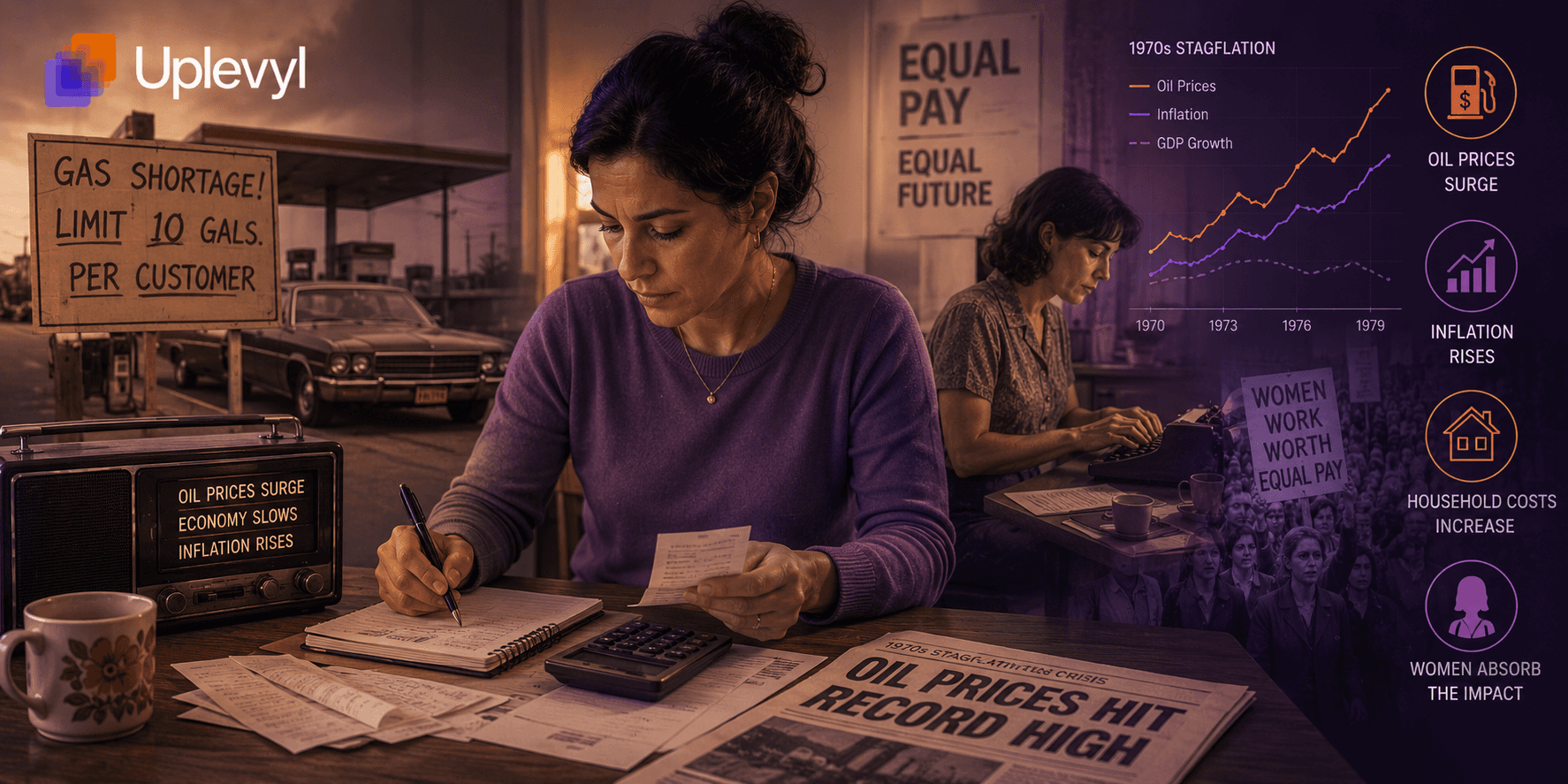
How Do Oil Crises Affect Women? (Part 1)
The 1970s stagflation crisis is almost always told as a story of markets. Here is the story it never told: who absorbed the shock, how they did it, and why it never made the data.
Table of Contents
Introduction
Was the 1970s Oil Crisis Really Measured in Markets, Not in Homes?
Why Did Women Enter the Workforce During a Moment of Instability?
How Did Inflation Become Invisible Labor?
Did Where Women Worked Shape How Hard They Were Hit?
Was the Impact Uniform Across All Women?
What Did the 1970s Actually Reveal About Who Carries a Crisis?
Frequently Asked Questions
Introduction
The 1970s oil crisis is usually remembered as a story of numbers. Oil prices surged. Inflation spiraled. Growth slowed. Economists called it stagflation, a rare and destabilizing combination of high inflation and weak economic output that confounded every textbook model of the era.
What is almost never remembered is who absorbed that shock in everyday life. While the data captured prices, wages, and unemployment, it failed to capture how households adapted. And within those households, the burden of adjustment fell unevenly, and disproportionately, on women.
Economic shocks do not operate in a vacuum. They move through systems that are already structured by inequality. What was missing from the data was not impact but visibility.
Was the 1970s Oil Crisis Really Measured in Markets, Not in Homes?
The economic record of the 1970s is detailed and widely studied. Inflation reached double digits across most advanced economies. In the United States, the consumer price index rose more than 11% in 1974 alone, driven in large part by the Arab oil embargo that began in October 1973 and sent crude oil prices up nearly 300% in a matter of months.
But there was a gap in how this story was told. Gender was not a primary lens of analysis at the time. Neither was the data broken down in ways that revealed how men and women experienced the same shock differently. The macroeconomic record captured what happened to prices and employment in aggregate. It did not capture what happened inside households or to the time, labor, and decision-making required to keep those households functioning.
During the 1973 oil embargo, crude oil prices rose approximately 300% within months, triggering the worst inflation the U.S. had seen since World War II.
Source: U.S. Energy Information Administration Historical Data; Bureau of Labor Statistics CPI Archive
The consequence is that the most vivid economic disruption of the 20th century was recorded without capturing the full cost it imposed. The numbers told us what the crisis did to markets. They did not tell us what it did to the people who managed the fallout at home.
Why Did Women Enter the Workforce During a Moment of Instability?
The 1970s marked a significant shift in women's participation in paid work. In the United States, the female labor force participation rate rose from roughly 43% in 1970 to nearly 52% by 1980, one of the steepest decade-long increases in recorded history.
This entry is often framed as progress. And structurally, it was. But timing matters enormously when evaluating what that entry meant in practice.
U.S. female labor force participation rose from ~43% in 1970 to ~52% by 1980, one of the steepest single-decade increases on record. (Source: U.S. Bureau of Labor Statistics, Women in the Labor Force: A Databook 2022 edition)
Women were not entering a stable, expanding economy. They were entering a labor market under acute stress, where jobs were scarce, growth was weak, and competition was rising. The primary driver behind much of this workforce entry was not opportunity but necessity. As inflation eroded household purchasing power, many families did not have the option to absorb the shock through savings or reduced consumption alone.
Women entered the workforce largely as a stabilizing response to economic pressure, often taking up roles that were available rather than optimal.
For many, this meant stepping into part-time, lower-paid, or less secure positions. The workforce expanded, but the quality of opportunity did not expand at the same pace. The labor market that welcomed women in the 1970s was not a labor market designed for them.
The 1970s workforce expansion for women was less a door opening and more a pressure valve releasing. The economy needed their labor. It did not redesign itself around them.
How Did Inflation Become Invisible Labor?
Inflation is usually discussed as a macroeconomic variable. Prices rise. Purchasing power falls. Households adjust. But adjustment is not automatic. It is managed, and the management of household economics during a period of sustained inflation represents a substantial body of work that simply does not appear in any national account.
During the oil crisis, the cost of essentials such as food, energy, and housing increased sharply. Gasoline prices more than doubled. Heating oil became a genuine hardship for low- and middle-income households. Grocery bills rose faster than wages.
U.S. food prices rose 14.5% in 1974, the steepest single-year increase since World War II. Energy costs rose even faster, with heating oil prices increasing by more than 40% in some regions.
Source: Bureau of Labor Statistics CPI Historical Tables; U.S. Department of Energy
Families made everyday decisions differently: spend less, substitute more, and stretch resources further. Cooking replaced convenience food. Planning replaced spontaneity. Care work expanded as external services such as childcare and home help became unaffordable. Time replaced money as the adjustment mechanism.
And in most households, this work was done by women. It represented real economic effort, real time, and real cognitive load, none of which was captured in any formal measure of economic output.
This is what economists and gender researchers now call the "care penalty" operating in reverse: during downturns, unpaid care work expands precisely as paid opportunities contract. The household becomes a site of economic absorption, and the people managing that absorption are largely invisible to the systems measuring the crisis.
Inflation did more than reduce income. It increased unpaid labor, and that increase was not evenly distributed.
Did Where Women Worked Shape How Hard They Were Hit?
Occupational concentration compounded the impact. Women in the 1970s were disproportionately employed in service roles, clerical work, and retail. These sectors share a common vulnerability: they respond quickly to economic stress, particularly the kind generated by an oil shock.
Oil-driven inflation compresses consumer discretionary spending while simultaneously raising operating costs for businesses. The result is pressure on exactly the sectors where women were most heavily represented. Employers reduced hours, slowed hiring, or cut roles. Part-time work became more common, and the job security that had defined clerical and administrative work in the postwar era began to erode.
In the mid-1970s, women made up approximately 80% of clerical workers and 65% of retail and service workers in the U.S. These were among the sectors most directly exposed to demand contraction during the oil crisis (Source: U.S. Census Bureau, Statistical Abstract of the United States, 1977)
This created a structural double bind. Women were entering the workforce in larger numbers, often to compensate for household income losses driven by the crisis. But they were entering into the sectors most likely to contract because of the same crisis. The workforce entry that looked like progress from the outside carried a specific risk profile that was rarely analyzed at the time.
At work: reduced stability, income volatility, and fewer hours.
At home: increased responsibility to manage rising costs with diminished resources.
In the data: neither burden was measured, making the combined load invisible to policymakers.
Was the Impact Uniform Across All Women?
It was not, and the gap matters. Even within the pattern described above, the crisis did not land evenly. The layering of race and gender produced markedly different outcomes.
Black women experienced unemployment rates approximately twice those of white women during the 1974-1975 recession, reflecting how macroeconomic shocks interact with and amplify pre-existing structural inequalities.
This is a recurring feature of macroeconomic disruption, not an anomaly. Economic shocks do not distribute harm randomly. They amplify whatever inequalities are already present in the system. For Black women in the 1970s, that meant entering a labor market carrying the compounding weight of both racial and gender discrimination, then absorbing a macroeconomic shock through the lens of both simultaneously.
The 1970s made clear that talking about "women's experience" of a crisis without disaggregating by race, class, and geography produces an analysis that is accurate for some women and misleading about most.
Women who were single heads of household faced a sharper version of every pressure described above, with no secondary income to buffer against inflation and no shared care arrangement to distribute unpaid labor. Women in rural areas, far from urban service economies and dependent on personal vehicle travel, faced disproportionate fuel cost burdens. The crisis had a structure; it did not fall randomly.
Economic shocks do not distribute harm evenly. They amplify what is already uneven. The 1970s demonstrated this with precision, even if the data at the time was too aggregated to show it clearly.
What Did the 1970s Actually Reveal About Who Carries a Crisis?
The 1970s oil crisis is remembered as an economic event. It was equally a social one, and the social dimension was nearly entirely absent from the analytical frameworks applied to it at the time.
Beneath the headline indicators, a quieter shift was underway. Women entered the workforce at scale, not from a position of expanded opportunity but from economic necessity. At the same time, they absorbed rising costs through unpaid labor that never entered formal measurement. The dual burden was invisible to the systems recording the crisis because those systems were not designed to see it.
What the 1970s revealed, in retrospect, is a structural pattern that recurs in every subsequent major economic disruption:
Macro shocks travel through systems already structured by inequality.
The sectors and roles most exposed to contraction are disproportionately occupied by women.
The unpaid labor that absorbs household-level shock is disproportionately performed by women.
The data that records the crisis is rarely designed to capture either form of burden.
The shock moved between markets and homes, between wages and time, between what was counted and what was not. The people managing the uncounted work were largely women.
A 2023 McKinsey Global Institute analysis found that unpaid care work, predominantly performed by women, would represent the world's largest economic sector if it were measured, estimated at $10-39 trillion annually depending on valuation method.
The 1970s did not create this pattern. It made it visible, briefly, to those looking closely enough. In the next part of this series, we turn to present oil crises and the question that follows: the tools to see this clearly now exist. The visibility is available. What remains is the question of what we choose to do with it.
The crisis revealed how macro shocks travel through systems that are structured unequally, and how that structure shapes who carries the weight, always invisibly, always without being counted.
Frequently Asked Questions
Why is the 1970s oil crisis relevant to understanding women's economic position today?
The 1970s established structural patterns that persist in every subsequent economic shock: women's concentration in vulnerable sectors, the expansion of unpaid care work during downturns, and the systematic undercounting of both. Current oil price volatility, post-pandemic inflation, and AI-driven labor disruption all operate through the same structural channels. Understanding 1970 is not historical nostalgia; it is pattern recognition for the present.
What is "stagflation" and why was it particularly damaging for working women?
Stagflation describes the simultaneous occurrence of high inflation and weak economic growth, a combination that is unusually damaging because it removes the standard policy responses: cutting rates to fight recession risks accelerating inflation, while raising rates to fight inflation deepens the employment contraction. For working women, this meant facing rising household costs at the same time that the sectors where they were concentrated were cutting hours and roles, with no policy tool capable of addressing both pressures simultaneously.
How do we know women performed more unpaid labor during the oil crisis if it was not measured?
The evidence comes from retrospective analysis of time-use surveys, household expenditure data, and sociological research conducted during and after the period. Economists including Nancy Folbre and Marilyn Waring, whose foundational work on the care economy was published in the 1980s and 1990s, used these sources to reconstruct the household-level dynamics the macroeconomic data missed. The argument is not speculative; it is reconstructed from available evidence and consistent with patterns documented in every subsequent measured crisis.
Did any policy interventions during the 1970s specifically address women's economic position?
No significant federal policy intervention during the 1970s was designed specifically around women's differential experience of the oil shock. The Emergency Petroleum Allocation Act and the Energy Policy and Conservation Act addressed supply and pricing; neither incorporated gender analysis. The Equal Credit Opportunity Act of 1974 improved women's access to credit, but was not designed as a crisis-response measure. This absence of gender-responsive policy during an acute economic shock is itself a finding that informs how we think about crisis policy design today.
This is Part 1 of a two-part series. Part 2 examines current oil price volatility and the question of what greater visibility demands of policymakers and institutions.
How Do Oil Crises Affect Women? (Part 1)
The 1970s stagflation crisis is almost always told as a story of markets. Here is the story it never told: who absorbed the shock, how they did it, and why it never made the data.
Table of Contents
Introduction
Was the 1970s Oil Crisis Really Measured in Markets, Not in Homes?
Why Did Women Enter the Workforce During a Moment of Instability?
How Did Inflation Become Invisible Labor?
Did Where Women Worked Shape How Hard They Were Hit?
Was the Impact Uniform Across All Women?
What Did the 1970s Actually Reveal About Who Carries a Crisis?
Frequently Asked Questions
Introduction
The 1970s oil crisis is usually remembered as a story of numbers. Oil prices surged. Inflation spiraled. Growth slowed. Economists called it stagflation, a rare and destabilizing combination of high inflation and weak economic output that confounded every textbook model of the era.
What is almost never remembered is who absorbed that shock in everyday life. While the data captured prices, wages, and unemployment, it failed to capture how households adapted. And within those households, the burden of adjustment fell unevenly, and disproportionately, on women.
Economic shocks do not operate in a vacuum. They move through systems that are already structured by inequality. What was missing from the data was not impact but visibility.
Was the 1970s Oil Crisis Really Measured in Markets, Not in Homes?
The economic record of the 1970s is detailed and widely studied. Inflation reached double digits across most advanced economies. In the United States, the consumer price index rose more than 11% in 1974 alone, driven in large part by the Arab oil embargo that began in October 1973 and sent crude oil prices up nearly 300% in a matter of months.
But there was a gap in how this story was told. Gender was not a primary lens of analysis at the time. Neither was the data broken down in ways that revealed how men and women experienced the same shock differently. The macroeconomic record captured what happened to prices and employment in aggregate. It did not capture what happened inside households or to the time, labor, and decision-making required to keep those households functioning.
During the 1973 oil embargo, crude oil prices rose approximately 300% within months, triggering the worst inflation the U.S. had seen since World War II.
Source: U.S. Energy Information Administration Historical Data; Bureau of Labor Statistics CPI Archive
The consequence is that the most vivid economic disruption of the 20th century was recorded without capturing the full cost it imposed. The numbers told us what the crisis did to markets. They did not tell us what it did to the people who managed the fallout at home.
Why Did Women Enter the Workforce During a Moment of Instability?
The 1970s marked a significant shift in women's participation in paid work. In the United States, the female labor force participation rate rose from roughly 43% in 1970 to nearly 52% by 1980, one of the steepest decade-long increases in recorded history.
This entry is often framed as progress. And structurally, it was. But timing matters enormously when evaluating what that entry meant in practice.
U.S. female labor force participation rose from ~43% in 1970 to ~52% by 1980, one of the steepest single-decade increases on record. (Source: U.S. Bureau of Labor Statistics, Women in the Labor Force: A Databook 2022 edition)
Women were not entering a stable, expanding economy. They were entering a labor market under acute stress, where jobs were scarce, growth was weak, and competition was rising. The primary driver behind much of this workforce entry was not opportunity but necessity. As inflation eroded household purchasing power, many families did not have the option to absorb the shock through savings or reduced consumption alone.
Women entered the workforce largely as a stabilizing response to economic pressure, often taking up roles that were available rather than optimal.
For many, this meant stepping into part-time, lower-paid, or less secure positions. The workforce expanded, but the quality of opportunity did not expand at the same pace. The labor market that welcomed women in the 1970s was not a labor market designed for them.
The 1970s workforce expansion for women was less a door opening and more a pressure valve releasing. The economy needed their labor. It did not redesign itself around them.
How Did Inflation Become Invisible Labor?
Inflation is usually discussed as a macroeconomic variable. Prices rise. Purchasing power falls. Households adjust. But adjustment is not automatic. It is managed, and the management of household economics during a period of sustained inflation represents a substantial body of work that simply does not appear in any national account.
During the oil crisis, the cost of essentials such as food, energy, and housing increased sharply. Gasoline prices more than doubled. Heating oil became a genuine hardship for low- and middle-income households. Grocery bills rose faster than wages.
U.S. food prices rose 14.5% in 1974, the steepest single-year increase since World War II. Energy costs rose even faster, with heating oil prices increasing by more than 40% in some regions.
Source: Bureau of Labor Statistics CPI Historical Tables; U.S. Department of Energy
Families made everyday decisions differently: spend less, substitute more, and stretch resources further. Cooking replaced convenience food. Planning replaced spontaneity. Care work expanded as external services such as childcare and home help became unaffordable. Time replaced money as the adjustment mechanism.
And in most households, this work was done by women. It represented real economic effort, real time, and real cognitive load, none of which was captured in any formal measure of economic output.
This is what economists and gender researchers now call the "care penalty" operating in reverse: during downturns, unpaid care work expands precisely as paid opportunities contract. The household becomes a site of economic absorption, and the people managing that absorption are largely invisible to the systems measuring the crisis.
Inflation did more than reduce income. It increased unpaid labor, and that increase was not evenly distributed.
Did Where Women Worked Shape How Hard They Were Hit?
Occupational concentration compounded the impact. Women in the 1970s were disproportionately employed in service roles, clerical work, and retail. These sectors share a common vulnerability: they respond quickly to economic stress, particularly the kind generated by an oil shock.
Oil-driven inflation compresses consumer discretionary spending while simultaneously raising operating costs for businesses. The result is pressure on exactly the sectors where women were most heavily represented. Employers reduced hours, slowed hiring, or cut roles. Part-time work became more common, and the job security that had defined clerical and administrative work in the postwar era began to erode.
In the mid-1970s, women made up approximately 80% of clerical workers and 65% of retail and service workers in the U.S. These were among the sectors most directly exposed to demand contraction during the oil crisis (Source: U.S. Census Bureau, Statistical Abstract of the United States, 1977)
This created a structural double bind. Women were entering the workforce in larger numbers, often to compensate for household income losses driven by the crisis. But they were entering into the sectors most likely to contract because of the same crisis. The workforce entry that looked like progress from the outside carried a specific risk profile that was rarely analyzed at the time.
At work: reduced stability, income volatility, and fewer hours.
At home: increased responsibility to manage rising costs with diminished resources.
In the data: neither burden was measured, making the combined load invisible to policymakers.
Was the Impact Uniform Across All Women?
It was not, and the gap matters. Even within the pattern described above, the crisis did not land evenly. The layering of race and gender produced markedly different outcomes.
Black women experienced unemployment rates approximately twice those of white women during the 1974-1975 recession, reflecting how macroeconomic shocks interact with and amplify pre-existing structural inequalities.
This is a recurring feature of macroeconomic disruption, not an anomaly. Economic shocks do not distribute harm randomly. They amplify whatever inequalities are already present in the system. For Black women in the 1970s, that meant entering a labor market carrying the compounding weight of both racial and gender discrimination, then absorbing a macroeconomic shock through the lens of both simultaneously.
The 1970s made clear that talking about "women's experience" of a crisis without disaggregating by race, class, and geography produces an analysis that is accurate for some women and misleading about most.
Women who were single heads of household faced a sharper version of every pressure described above, with no secondary income to buffer against inflation and no shared care arrangement to distribute unpaid labor. Women in rural areas, far from urban service economies and dependent on personal vehicle travel, faced disproportionate fuel cost burdens. The crisis had a structure; it did not fall randomly.
Economic shocks do not distribute harm evenly. They amplify what is already uneven. The 1970s demonstrated this with precision, even if the data at the time was too aggregated to show it clearly.
What Did the 1970s Actually Reveal About Who Carries a Crisis?
The 1970s oil crisis is remembered as an economic event. It was equally a social one, and the social dimension was nearly entirely absent from the analytical frameworks applied to it at the time.
Beneath the headline indicators, a quieter shift was underway. Women entered the workforce at scale, not from a position of expanded opportunity but from economic necessity. At the same time, they absorbed rising costs through unpaid labor that never entered formal measurement. The dual burden was invisible to the systems recording the crisis because those systems were not designed to see it.
What the 1970s revealed, in retrospect, is a structural pattern that recurs in every subsequent major economic disruption:
Macro shocks travel through systems already structured by inequality.
The sectors and roles most exposed to contraction are disproportionately occupied by women.
The unpaid labor that absorbs household-level shock is disproportionately performed by women.
The data that records the crisis is rarely designed to capture either form of burden.
The shock moved between markets and homes, between wages and time, between what was counted and what was not. The people managing the uncounted work were largely women.
A 2023 McKinsey Global Institute analysis found that unpaid care work, predominantly performed by women, would represent the world's largest economic sector if it were measured, estimated at $10-39 trillion annually depending on valuation method.
The 1970s did not create this pattern. It made it visible, briefly, to those looking closely enough. In the next part of this series, we turn to present oil crises and the question that follows: the tools to see this clearly now exist. The visibility is available. What remains is the question of what we choose to do with it.
The crisis revealed how macro shocks travel through systems that are structured unequally, and how that structure shapes who carries the weight, always invisibly, always without being counted.
Frequently Asked Questions
Why is the 1970s oil crisis relevant to understanding women's economic position today?
The 1970s established structural patterns that persist in every subsequent economic shock: women's concentration in vulnerable sectors, the expansion of unpaid care work during downturns, and the systematic undercounting of both. Current oil price volatility, post-pandemic inflation, and AI-driven labor disruption all operate through the same structural channels. Understanding 1970 is not historical nostalgia; it is pattern recognition for the present.
What is "stagflation" and why was it particularly damaging for working women?
Stagflation describes the simultaneous occurrence of high inflation and weak economic growth, a combination that is unusually damaging because it removes the standard policy responses: cutting rates to fight recession risks accelerating inflation, while raising rates to fight inflation deepens the employment contraction. For working women, this meant facing rising household costs at the same time that the sectors where they were concentrated were cutting hours and roles, with no policy tool capable of addressing both pressures simultaneously.
How do we know women performed more unpaid labor during the oil crisis if it was not measured?
The evidence comes from retrospective analysis of time-use surveys, household expenditure data, and sociological research conducted during and after the period. Economists including Nancy Folbre and Marilyn Waring, whose foundational work on the care economy was published in the 1980s and 1990s, used these sources to reconstruct the household-level dynamics the macroeconomic data missed. The argument is not speculative; it is reconstructed from available evidence and consistent with patterns documented in every subsequent measured crisis.
Did any policy interventions during the 1970s specifically address women's economic position?
No significant federal policy intervention during the 1970s was designed specifically around women's differential experience of the oil shock. The Emergency Petroleum Allocation Act and the Energy Policy and Conservation Act addressed supply and pricing; neither incorporated gender analysis. The Equal Credit Opportunity Act of 1974 improved women's access to credit, but was not designed as a crisis-response measure. This absence of gender-responsive policy during an acute economic shock is itself a finding that informs how we think about crisis policy design today.