
How Is AI Reinforcing the Motherhood Penalty?
The following article was written ahead of Mother's Day in May 2026.
Table of Contents
1. Introduction
2. What Is the Real Financial Cost of Becoming a Mother at Work?
3. How Are Algorithms Making Caregiver Bias Faster and Harder to See?
4. Where Does the Legal System Leave Working Mothers?
5. What Does AI That Actually Works for Caregivers Look Like?
6. What Can Organizations, Women, and AI Builders Do Right Now?
7. FAQs
1. Introduction
This weekend, many of us will buy flowers, write cards, and celebrate the women who raised us. What we will not celebrate is the economic punishment those same women absorbed simply for becoming mothers.
The motherhood penalty is not a sentiment. It is a data point with a dollar sign attached. And in an era where AI is quietly reshaping every hiring, scheduling, and performance review decision at work, the question of whether that penalty will be automated into permanence or finally dismantled is one of the most consequential equity questions of our time.
$500,000 is the average career-long pay penalty for mothers in the United States, according to a 2024 analysis drawing on U.S. Census Bureau data. This figure is the result of a labor market that was designed around the fiction of a worker with no caregiving responsibilities.
The arrival of AI in HR systems does not change that design flaw automatically. Without deliberate intervention, it accelerates it. But the inverse is also true: AI built with caregivers at the design table has the potential to close access gaps that have persisted for decades. The outcome is a choice. This blog examines what that choice requires.
2. What Is the Real Financial Cost of Becoming a Mother at Work?
The scale of what working mothers absorb financially is still treated as background noise rather than a structural emergency. The data does not support that treatment.
According to the 2025 AARP Caregiving in the US report, 70% of the nation's 63 million unpaid caregivers are also employed. The burden of that dual role falls overwhelmingly on women. In 2025 alone, approximately 400,000 women left the U.S. workforce, many citing caregiving demands they could no longer balance against inflexible employer expectations.
Half of all working caregivers report direct employment impacts from their caregiving responsibilities: reduced hours, missed promotions, denied accommodations, or outright job loss.
These are not isolated incidents. They are the systemic output of a labor market architecture that has never been redesigned around the realities of caregiving work.
The financial consequences are not abstract. The motherhood penalty translates to real differences in retirement security, in the ability to absorb a medical emergency, in the generational wealth a mother is able to pass on.
The 2025 FlexJobs Working Parents Report documents a workforce in which flexibility is the single most requested accommodation and one of the least reliably granted. Working mothers report navigating scheduling systems that assume availability they do not have, performance review frameworks that penalize the career gaps they were legally allowed to take, and hiring processes that filter them out before a human being ever sees their resume.
3. How Are Algorithms Making Caregiver Bias Faster and Harder to See?
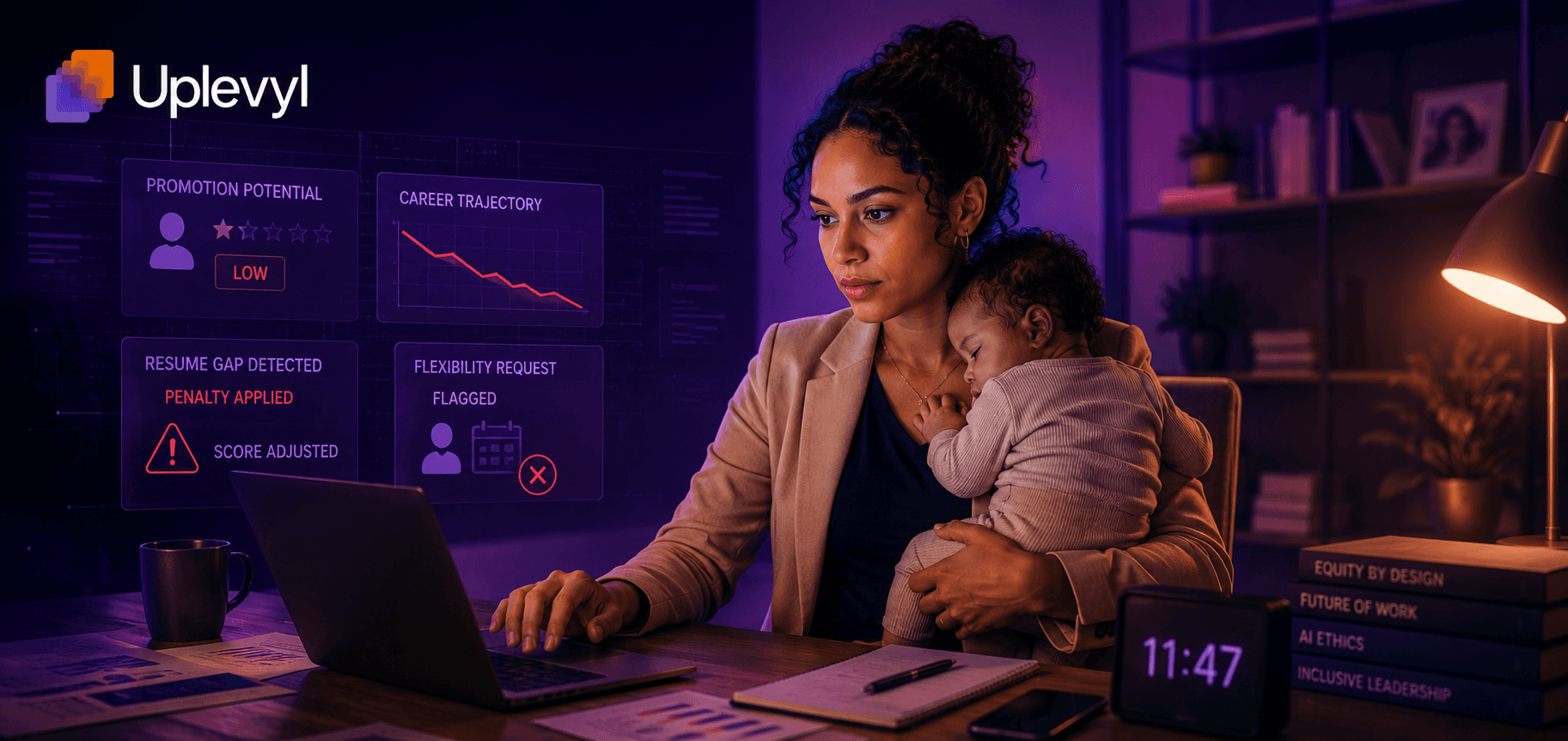
For decades, the motherhood penalty was enforced by human managers making biased assumptions in the moment: that a pregnant candidate is less committed, that a mother asking for flexibility is less serious, that a woman returning from leave has fallen behind. AI-powered hiring and HR tools are making this problem considerably more complex.
Research from Cornell University confirms that algorithmic systems trained on historical employment data can encode and amplify caregiver bias at speed and scale.
A system trained on who has historically been promoted in a given company will, without deliberate correction, learn to deprioritize candidates who look like they might take caregiving leave.
Algorithmic decisions often carry no explanation and leave no paper trail that a working mother can point to and say: this is where the bias happened.
This is a materially different accountability problem from the one that existed with human decision-makers. When a hiring manager passes on a candidate because she has a gap on her resume, that decision can, in principle, be challenged. When an AI system scores her application before it reaches a human reviewer, the bias is embedded in a layer most organizations do not audit, and most candidates never see.
The speed dimension compounds the problem. AI systems process hundreds of applications in the time a hiring manager would review one. Bias that once operated at human scale now operates at industrial scale, and the infrastructure to detect and correct it is not keeping pace with the infrastructure to deploy it.
4. Where Does the Legal System Leave Working Mothers?
Legal protections for working caregivers exist. Pregnancy accommodation rights, leave entitlements, and anti-discrimination statutes have expanded significantly in recent years. The Pregnant Workers Fairness Act, signed into law in 2023 and now in force, requires most employers to provide reasonable accommodations for pregnancy-related conditions. These are meaningful protections on paper.
The gap between the rights that exist on paper and the rights that mothers can actually exercise is enormous. According to Harvard Law School's Center on the Legal Profession, only 3% of advocacy organizations operating in this space maintain active helplines with the capacity to meet demand.
A woman in rural Mississippi with no access to a gender justice lawyer has the same starting point as a woman in San Francisco with a law firm on speed dial. They should not have to.
Protections are distributed across thousands of jurisdictions, frequently outdated in online summaries, and structurally inaccessible to the women who need them most. The employer who violates them typically has legal infrastructure to defend against challenge. The employee who was wronged typically does not. And AI, if built carelessly, risks widening that asymmetry further by making discriminatory decisions faster and at greater scale than any human HR department could.
5. What Does AI That Actually Works for Caregivers Look Like?
There is a meaningful distinction between AI that is deployed at women and AI that is built for women, with women at the design table, women's lived experiences in the training data, and women's rights as the organizing principle.
Most general-purpose AI tools reflect the same assumptions about work, productivity, and ideal workers that have governed labor markets for a century. The worker they model is available full-time, has an uninterrupted career history, and does not need schedule accommodations. Every caregiver is, by that standard, a deviation from the norm.
Uplevyl is currently developing a purpose-built AI system designed to close the access-to-justice gap for working caregivers. Its design objective is to translate fragmented, jurisdiction-specific workplace protections into plain-language, real-time guidance that a working mother can actually use, whether she is being pushed out of a job after her pregnancy, denied a schedule adjustment she is legally entitled to, or trying to understand her rights before a difficult conversation with HR.
This kind of AI does not replace advocates, attorneys, or human expertise. It helps to scale them. The work is being built in deep collaboration with gender justice organizations that have spent decades in direct service to working mothers. Their expertise is the foundation the technology is built on, not an afterthought.
Equitable AI infrastructure does not just serve the women who already have access to lawyers and advocates. It starts by reaching the ones who have neither.
6. What Can Organizations, Women, and AI Builders Do Right Now?
The caregiving crisis in the workforce is not going to resolve itself. The algorithmic bias baked into hiring and performance systems is not going to self-correct. Both require deliberate, structural action.
For organizations:
Audit your AI-powered HR tools for caregiver bias. If your system has not been evaluated for whether it disadvantages candidates or employees with caregiving histories, it almost certainly has not been designed to avoid doing so. Publish clear, written accommodation policies for pregnancy, lactation, and caregiving, and ensure managers are trained to implement them without requiring women to navigate a legal process to access rights they are already entitled to. Build flexibility by design, not by exception. Flexible scheduling should be the default offer, not the outcome of an individual negotiation that most women do not know they are allowed to have.
For women navigating these systems right now:
Document everything: requests for accommodation, the responses you receive, any changes to your role or compensation after a pregnancy or caregiving disclosure. The Pregnant Workers Fairness Act requires most employers to provide reasonable accommodations for pregnancy-related conditions. Federal and state protections have expanded significantly, and many employers count on employees not knowing what applies. Connect with gender justice advocacy organizations that can help you understand what rights apply to your specific situation.
For investors, technologists, and AI builders:
Fund gender-intelligent AI. The gap between what working mothers need from AI and what general-purpose tools provide will not close on its own. It requires investment in purpose-built infrastructure. Demand bias evaluations that include caregiving status as a protected category. Measure what you claim to care about. Equity in AI is not a values statement. It is testing, transparency, and accountability to the communities the system is supposed to serve.
7. FAQs
1. What is the motherhood penalty, and how large is it?
The motherhood penalty refers to the career-long wage, promotion, and opportunity gap that women experience after becoming mothers, relative to both men and childless women. A 2024 analysis drawing on U.S. Census Bureau data estimates the average career-long pay penalty for mothers in the United States at $500,000. The penalty is not uniform: it is larger for women in lower-wage roles, for women of color, and for single mothers, and it compounds over time through reduced retirement savings and diminished financial resilience.
2. How exactly does AI encode and amplify caregiver bias?
AI hiring and HR systems are trained on historical data: who was hired, who was promoted, who was retained. If those historical outcomes reflect caregiver bias, which they almost universally do in labor markets that were not designed for workers with caregiving responsibilities, the system learns to replicate those outcomes. It does not do this through conscious discrimination. It does it by identifying patterns associated with past success and treating deviations from those patterns as indicators of lower suitability. Career gaps, part-time history, and schedule flexibility requests are among the signals that can trigger this effect.
3. What legal protections do working mothers in the U.S. have, and are they enforceable?
The primary federal protections include the Pregnant Workers Fairness Act (2023), which requires most employers to provide reasonable accommodations for pregnancy-related conditions; the Pregnancy Discrimination Act; the Family and Medical Leave Act; and provisions of Title VII. Many states have additional protections that go further than federal law. The challenge is not primarily the existence of protections but their enforceability. According to Harvard Law School's Center on the Legal Profession, only 3% of advocacy organizations in this space maintain active helplines with capacity to meet demand, meaning most working mothers have no practical pathway to exercise the rights they hold on paper.
4. What makes an AI system genuinely useful to working caregivers, rather than just marketed to them?
Genuinely useful caregiver AI starts from the design stage, not the marketing stage. It means training data that includes caregiver experiences, not just the default full-time, uninterrupted career model. It means plain-language output that translates legal complexity into actionable guidance a non-lawyer can use. It means building in collaboration with organizations that have direct service experience with the populations the tool is meant to reach. And it means accountability structures: ongoing testing for bias, transparent reporting on outcomes, and mechanisms for the communities served to provide feedback that shapes how the system evolves.
5. What is the Pregnant Workers Fairness Act, and what does it actually require of employers?
The Pregnant Workers Fairness Act, signed into law in 2023, requires most U.S. employers with 15 or more employees to provide reasonable accommodations for known limitations related to pregnancy, childbirth, or related medical conditions, unless doing so would impose an undue hardship. Accommodations can include schedule modifications, remote work, temporary reassignment, and other adjustments. The Act also prohibits employers from requiring employees to take leave if another reasonable accommodation is available. It is one of the most significant expansions of workplace protections for pregnant workers in decades, and most working mothers have not been told it exists.
How Is AI Reinforcing the Motherhood Penalty?
The following article was written ahead of Mother's Day in May 2026.
Table of Contents
1. Introduction
2. What Is the Real Financial Cost of Becoming a Mother at Work?
3. How Are Algorithms Making Caregiver Bias Faster and Harder to See?
4. Where Does the Legal System Leave Working Mothers?
5. What Does AI That Actually Works for Caregivers Look Like?
6. What Can Organizations, Women, and AI Builders Do Right Now?
7. FAQs
1. Introduction
This weekend, many of us will buy flowers, write cards, and celebrate the women who raised us. What we will not celebrate is the economic punishment those same women absorbed simply for becoming mothers.
The motherhood penalty is not a sentiment. It is a data point with a dollar sign attached. And in an era where AI is quietly reshaping every hiring, scheduling, and performance review decision at work, the question of whether that penalty will be automated into permanence or finally dismantled is one of the most consequential equity questions of our time.
$500,000 is the average career-long pay penalty for mothers in the United States, according to a 2024 analysis drawing on U.S. Census Bureau data. This figure is the result of a labor market that was designed around the fiction of a worker with no caregiving responsibilities.
The arrival of AI in HR systems does not change that design flaw automatically. Without deliberate intervention, it accelerates it. But the inverse is also true: AI built with caregivers at the design table has the potential to close access gaps that have persisted for decades. The outcome is a choice. This blog examines what that choice requires.
2. What Is the Real Financial Cost of Becoming a Mother at Work?
The scale of what working mothers absorb financially is still treated as background noise rather than a structural emergency. The data does not support that treatment.
According to the 2025 AARP Caregiving in the US report, 70% of the nation's 63 million unpaid caregivers are also employed. The burden of that dual role falls overwhelmingly on women. In 2025 alone, approximately 400,000 women left the U.S. workforce, many citing caregiving demands they could no longer balance against inflexible employer expectations.
Half of all working caregivers report direct employment impacts from their caregiving responsibilities: reduced hours, missed promotions, denied accommodations, or outright job loss.
These are not isolated incidents. They are the systemic output of a labor market architecture that has never been redesigned around the realities of caregiving work.
The financial consequences are not abstract. The motherhood penalty translates to real differences in retirement security, in the ability to absorb a medical emergency, in the generational wealth a mother is able to pass on.
The 2025 FlexJobs Working Parents Report documents a workforce in which flexibility is the single most requested accommodation and one of the least reliably granted. Working mothers report navigating scheduling systems that assume availability they do not have, performance review frameworks that penalize the career gaps they were legally allowed to take, and hiring processes that filter them out before a human being ever sees their resume.
3. How Are Algorithms Making Caregiver Bias Faster and Harder to See?
For decades, the motherhood penalty was enforced by human managers making biased assumptions in the moment: that a pregnant candidate is less committed, that a mother asking for flexibility is less serious, that a woman returning from leave has fallen behind. AI-powered hiring and HR tools are making this problem considerably more complex.
Research from Cornell University confirms that algorithmic systems trained on historical employment data can encode and amplify caregiver bias at speed and scale.
A system trained on who has historically been promoted in a given company will, without deliberate correction, learn to deprioritize candidates who look like they might take caregiving leave.
Algorithmic decisions often carry no explanation and leave no paper trail that a working mother can point to and say: this is where the bias happened.
This is a materially different accountability problem from the one that existed with human decision-makers. When a hiring manager passes on a candidate because she has a gap on her resume, that decision can, in principle, be challenged. When an AI system scores her application before it reaches a human reviewer, the bias is embedded in a layer most organizations do not audit, and most candidates never see.
The speed dimension compounds the problem. AI systems process hundreds of applications in the time a hiring manager would review one. Bias that once operated at human scale now operates at industrial scale, and the infrastructure to detect and correct it is not keeping pace with the infrastructure to deploy it.
4. Where Does the Legal System Leave Working Mothers?
Legal protections for working caregivers exist. Pregnancy accommodation rights, leave entitlements, and anti-discrimination statutes have expanded significantly in recent years. The Pregnant Workers Fairness Act, signed into law in 2023 and now in force, requires most employers to provide reasonable accommodations for pregnancy-related conditions. These are meaningful protections on paper.
The gap between the rights that exist on paper and the rights that mothers can actually exercise is enormous. According to Harvard Law School's Center on the Legal Profession, only 3% of advocacy organizations operating in this space maintain active helplines with the capacity to meet demand.
A woman in rural Mississippi with no access to a gender justice lawyer has the same starting point as a woman in San Francisco with a law firm on speed dial. They should not have to.
Protections are distributed across thousands of jurisdictions, frequently outdated in online summaries, and structurally inaccessible to the women who need them most. The employer who violates them typically has legal infrastructure to defend against challenge. The employee who was wronged typically does not. And AI, if built carelessly, risks widening that asymmetry further by making discriminatory decisions faster and at greater scale than any human HR department could.
5. What Does AI That Actually Works for Caregivers Look Like?
There is a meaningful distinction between AI that is deployed at women and AI that is built for women, with women at the design table, women's lived experiences in the training data, and women's rights as the organizing principle.
Most general-purpose AI tools reflect the same assumptions about work, productivity, and ideal workers that have governed labor markets for a century. The worker they model is available full-time, has an uninterrupted career history, and does not need schedule accommodations. Every caregiver is, by that standard, a deviation from the norm.
Uplevyl is currently developing a purpose-built AI system designed to close the access-to-justice gap for working caregivers. Its design objective is to translate fragmented, jurisdiction-specific workplace protections into plain-language, real-time guidance that a working mother can actually use, whether she is being pushed out of a job after her pregnancy, denied a schedule adjustment she is legally entitled to, or trying to understand her rights before a difficult conversation with HR.
This kind of AI does not replace advocates, attorneys, or human expertise. It helps to scale them. The work is being built in deep collaboration with gender justice organizations that have spent decades in direct service to working mothers. Their expertise is the foundation the technology is built on, not an afterthought.
Equitable AI infrastructure does not just serve the women who already have access to lawyers and advocates. It starts by reaching the ones who have neither.
6. What Can Organizations, Women, and AI Builders Do Right Now?
The caregiving crisis in the workforce is not going to resolve itself. The algorithmic bias baked into hiring and performance systems is not going to self-correct. Both require deliberate, structural action.
For organizations:
Audit your AI-powered HR tools for caregiver bias. If your system has not been evaluated for whether it disadvantages candidates or employees with caregiving histories, it almost certainly has not been designed to avoid doing so. Publish clear, written accommodation policies for pregnancy, lactation, and caregiving, and ensure managers are trained to implement them without requiring women to navigate a legal process to access rights they are already entitled to. Build flexibility by design, not by exception. Flexible scheduling should be the default offer, not the outcome of an individual negotiation that most women do not know they are allowed to have.
For women navigating these systems right now:
Document everything: requests for accommodation, the responses you receive, any changes to your role or compensation after a pregnancy or caregiving disclosure. The Pregnant Workers Fairness Act requires most employers to provide reasonable accommodations for pregnancy-related conditions. Federal and state protections have expanded significantly, and many employers count on employees not knowing what applies. Connect with gender justice advocacy organizations that can help you understand what rights apply to your specific situation.
For investors, technologists, and AI builders:
Fund gender-intelligent AI. The gap between what working mothers need from AI and what general-purpose tools provide will not close on its own. It requires investment in purpose-built infrastructure. Demand bias evaluations that include caregiving status as a protected category. Measure what you claim to care about. Equity in AI is not a values statement. It is testing, transparency, and accountability to the communities the system is supposed to serve.
7. FAQs
1. What is the motherhood penalty, and how large is it?
The motherhood penalty refers to the career-long wage, promotion, and opportunity gap that women experience after becoming mothers, relative to both men and childless women. A 2024 analysis drawing on U.S. Census Bureau data estimates the average career-long pay penalty for mothers in the United States at $500,000. The penalty is not uniform: it is larger for women in lower-wage roles, for women of color, and for single mothers, and it compounds over time through reduced retirement savings and diminished financial resilience.
2. How exactly does AI encode and amplify caregiver bias?
AI hiring and HR systems are trained on historical data: who was hired, who was promoted, who was retained. If those historical outcomes reflect caregiver bias, which they almost universally do in labor markets that were not designed for workers with caregiving responsibilities, the system learns to replicate those outcomes. It does not do this through conscious discrimination. It does it by identifying patterns associated with past success and treating deviations from those patterns as indicators of lower suitability. Career gaps, part-time history, and schedule flexibility requests are among the signals that can trigger this effect.
3. What legal protections do working mothers in the U.S. have, and are they enforceable?
The primary federal protections include the Pregnant Workers Fairness Act (2023), which requires most employers to provide reasonable accommodations for pregnancy-related conditions; the Pregnancy Discrimination Act; the Family and Medical Leave Act; and provisions of Title VII. Many states have additional protections that go further than federal law. The challenge is not primarily the existence of protections but their enforceability. According to Harvard Law School's Center on the Legal Profession, only 3% of advocacy organizations in this space maintain active helplines with capacity to meet demand, meaning most working mothers have no practical pathway to exercise the rights they hold on paper.
4. What makes an AI system genuinely useful to working caregivers, rather than just marketed to them?
Genuinely useful caregiver AI starts from the design stage, not the marketing stage. It means training data that includes caregiver experiences, not just the default full-time, uninterrupted career model. It means plain-language output that translates legal complexity into actionable guidance a non-lawyer can use. It means building in collaboration with organizations that have direct service experience with the populations the tool is meant to reach. And it means accountability structures: ongoing testing for bias, transparent reporting on outcomes, and mechanisms for the communities served to provide feedback that shapes how the system evolves.
5. What is the Pregnant Workers Fairness Act, and what does it actually require of employers?
The Pregnant Workers Fairness Act, signed into law in 2023, requires most U.S. employers with 15 or more employees to provide reasonable accommodations for known limitations related to pregnancy, childbirth, or related medical conditions, unless doing so would impose an undue hardship. Accommodations can include schedule modifications, remote work, temporary reassignment, and other adjustments. The Act also prohibits employers from requiring employees to take leave if another reasonable accommodation is available. It is one of the most significant expansions of workplace protections for pregnant workers in decades, and most working mothers have not been told it exists.