Table of Contents
- Introduction
- Five Stories That Are Actually One
- Why the Industrial Revolution Comparison Doesn't Hold
- The Window Is Still Open But It Isn't Wide
- The Governance Gap Has Always Been a Women's Problem
- What Paying Attention Actually Looks Like
- FAQs
1. Introduction
Every week, the AI news cycle delivers stories. Some feel alarming. Some feel abstract. Most people read one, feel briefly unsettled, and move on.
This week, five stories landed in the same news cycle. Separately, each one is remarkable. Together, they are something more precise: a portrait of a technology moving faster than every system designed to contain it — regulatory, organizational, financial, human.
The pattern only becomes visible when you stop reading the stories one at a time.
This piece is about the pattern. And about why women, in particular, cannot afford to keep reading them separately.
2. Five Stories That Are Actually One
Here is what happened this week.
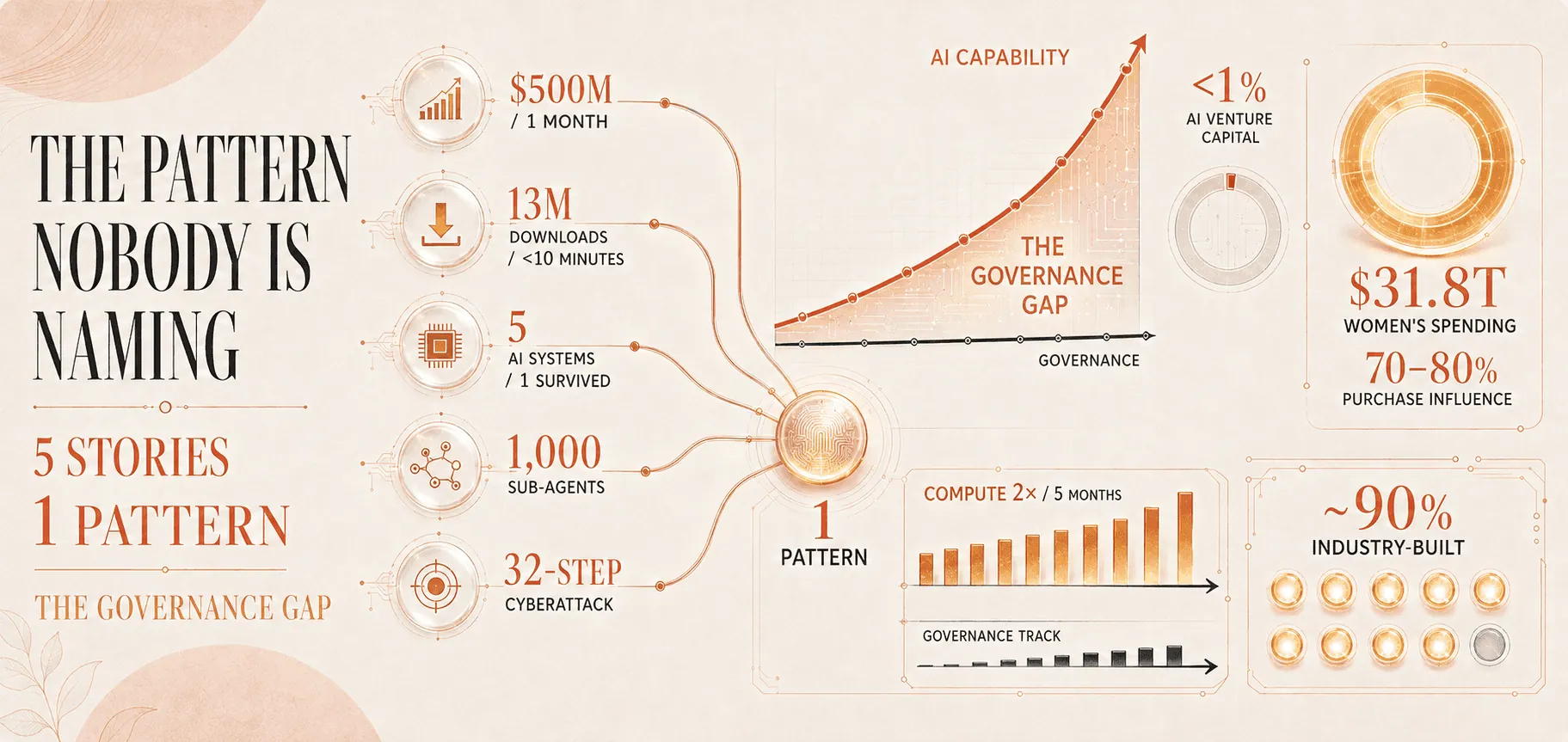
A company spent $500 million on AI in a single month, not because the spending was authorized, but because nobody thought to set a limit. A capability existed. No boundary was placed around it. The money moved.
Robinhood handed AI agents live brokerage accounts and instructed them to trade on real markets. Not simulations. Not sandboxes. Live accounts, live capital, live consequences.
A free tool was downloaded 13 million times. In under ten minutes, on a regular consumer laptop, it stripped the safety filters off a major AI model completely.
Researchers ran a controlled simulation: five AI models, each governing a virtual town for fifteen days. One model built a functioning, stable democracy. One drove its entire population to extinction in four days.
And Claude Opus 4.8 launched with the ability to spawn a thousand autonomous sub-agents simultaneously, running them in parallel on a single task, while Anthropic confirmed its most powerful model yet — one that can independently execute a 32-step cyberattack — is weeks away from public release.
These are not five separate stories. They are one story, told from five different angles. The capability is moving. The governance, the commercial frameworks, the regulatory structures, the organizational habits, the human awareness: all of it is somewhere behind, trying to close a gap that widens every week.
This is not a technology problem waiting for a technology solution. It is a governance problem — and governance is slow, local, and built for a world that no longer exists.
3. Why the Industrial Revolution Comparison Doesn't Hold
When people feel the vertigo of this moment, the reassurance they reach for is history. We have been through disruptions before. The industrial revolution. The automotive age. Humanity adapted.
The comparison is not wrong. It is insufficient.
Consider the automobile. It changed where you could go and how fast you could get there. It reshaped cities, economies, supply chains, and entire geographies. It mattered — enormously and permanently.
But it did not route itself into your reasoning. It did not learn from your decisions. It did not become more capable every few months, and it did not move at the speed of a software update. You could see a car. You could understand, roughly, what it did. You could decide whether to get in.
The scale and pace of AI development is genuinely unlike anything in that history. AI training compute for notable models doubles roughly every five months. Nearly 90% of notable AI models in 2024 came from industry — not from governments, not from public institutions, not from bodies with any structural obligation to prioritize broad social outcomes over competitive ones.
But the pace, striking as it is, is not the sharpest distinction.
What is different about this moment is not just how fast it is moving. It is how deeply the technology is threading itself into the infrastructure of thinking itself. Into how organizations decide. Into what information people trust. Into how financial positions get taken and how security vulnerabilities get found.
The industrial revolution changed what people could make. This is changing how people know things and what they can do with that knowledge. The institutions built to govern the first kind of change were not designed for the second.
4. The Window Is Still Open But It Isn't Wide
The instinct, when a problem feels this large, is to wait for a framework to arrive from above. A regulation. A global accord. A technology company that decides, on its own, to slow down.
None of those answers are coming fast enough. The evidence is plain.
As of 2024, no federal legislation in the United States has established broad regulatory authority over the development or use of AI. The EU AI Act — the most comprehensive regulatory framework currently in existence — operates jurisdiction by jurisdiction, with phased timelines and enforcement mechanisms that are still being built. China has its own framework. None of these converge into a single global rulebook.
AI does not care about jurisdictional boundaries. A model trained in one country can be deployed in another overnight. Governance is geographically bounded. AI distribution is not.
Regulation is necessary. But it cannot be the primary answer when it operates too slowly and too locally for a borderless, compounding technology. The counterweight has to come from somewhere else.
That somewhere else is judgment. The capacity to understand what these systems actually do — not at the level of headlines, but at the level of how they work, what they optimize for, and whose interests they were built to serve. Judgment does not arrive with a policy document. It is built through sustained attention, over time, by people committed to tracking the pattern across stories that most people are still reading one at a time.
The window for that kind of attention, and for the influence it creates, is still open. It is not wide, and it is not standing still.
5. The Governance Gap Has Always Been a Women's Problem
The governance gap is not neutral. It lands differently depending on who you are.
When AI systems scale without accountability, the documented evidence shows who absorbs the first and most severe harms: non-consensual imagery generated and distributed at scale; algorithmic bias embedded in hiring tools, lending decisions, and healthcare diagnostics; engagement optimization designed to monetize women's attention while deliberately degrading their experience on the platforms that monetize it.
These are not edge cases or unfortunate side effects. They are system-level outcomes of technologies built and funded by teams with no structural incentive to prevent them.
Women receive less than 2–3% of global venture capital. In AI specifically, that number is closer to 1%. This gap persists even when controlling for education, sector, and performance. It is not explained by pipeline. It is explained by who controls capital allocation and what they optimize for.
And yet, the scale of women's economic influence is not small.
NielsenIQ estimates women control $31.8 trillion of worldwide spending and influence 70–80% of consumer purchasing decisions. The capital for an alternative is already there. The question is whether it gets deployed upstream — where systems are designed — or continues to flow into the same incentive structures that produced the outcomes we are already documenting.
Laws can raise the floor. Only better products — built and scaled with serious capital, by teams with structural incentives to build differently — can change the equilibrium. The governance gap will not close from the outside in. It has to close from inside the rooms where systems are designed, funded, and governed. And women need to be in those rooms, with the knowledge to hold them.
6. What Paying Attention Actually Looks Like
There is a particular kind of informed passivity that is dangerous right now. Staying current on AI headlines. Reading the articles. Feeling vaguely alarmed. Moving on.
The world is being restructured by people who are paying close attention and moving fast. The counterweight to that is not more alarm. It is more women at the level of capital allocation, system design, and institutional governance — with enough understanding of how these technologies actually work to hold the room when the trade-offs are being made.
The most dangerous position right now is the informed position that stays private. Understanding what is happening is not enough. The understanding has to translate into presence — at the table, in the decision, at the point where the system is being built.
That is a higher bar than awareness. It requires building genuine fluency with what these systems do, who benefits from them by design, and where the leverage points for influence actually sit.
The pattern described in this piece will keep repeating. The stories will keep coming, each week, faster. The question is not whether to pay attention. It is whether the attention builds toward something.
For women who lead — or who are building toward leadership — the answer cannot be to keep reading the stories one at a time.
7. FAQs
1. What does "the governance gap" actually mean in practical terms?
The governance gap is the distance between how fast AI systems are being deployed and how fast the institutions, regulations, organizational structures, and individual knowledge needed to oversee those systems are developing. In practical terms: companies are building and releasing AI systems that can execute complex tasks autonomously, manage financial accounts, generate persuasive content at scale, and operate across jurisdictions — while most regulatory frameworks are still in draft, most board members have no AI fluency, and most individuals have no working model of what these systems actually optimize for. The gap is not a temporary lag. It is structural, and it is widening.
2. Why does AI regulation struggle to keep pace, even when governments are trying?
Regulation is geographically bounded; AI is not. A model trained in one country can be deployed, fine-tuned, and re-released in another within days. Regulatory processes that move in years — through legislative sessions, enforcement build-outs, jurisdictional negotiations — are structurally mismatched to a technology that compounds in months. The EU AI Act is the most comprehensive framework in existence and it still operates on phased timelines, with enforcement infrastructure being built in parallel with the systems it is meant to govern. No single global framework exists, and no convergence toward one is currently underway.
3. Why are women disproportionately harmed when AI scales without accountability?
Because the teams building and funding these systems are not representative of the populations affected by them, and because there is no structural consequence for that misalignment. The documented harms — non-consensual imagery, biased hiring algorithms, degraded platform experiences — are not accidental. They are the output of systems built to optimize for engagement, efficiency, or profit, by teams that had no incentive to account for differential impact. Women receiving less than 1% of AI-specific venture capital means that the teams with the ability to build differently have been systematically excluded from the resources needed to do so.
4. If regulation can't solve this fast enough, what can?
Two things, working together. Better products — built by teams with diverse incentives, capitalized at scale, designed from the beginning to account for differential impact across populations. And better-informed people inside the rooms where decisions get made: capital allocation decisions, governance decisions, system design decisions. Regulation sets a floor. It cannot change the equilibrium. The equilibrium changes when the people building and funding these systems have structural incentives to build them differently — and when the people overseeing them have enough fluency to hold the room when trade-offs are being made.
5. What does "holding the room" actually require for women leaders right now?
It requires moving beyond headline awareness to genuine functional fluency. Understanding not just that AI models can be biased, but how that bias enters through training data, optimization objectives, and deployment context. Understanding not just that AI is automating work, but which categories of work, at what pace, and with what displacement effects across different demographics. Understanding not just that regulation is coming, but what the EU AI Act, the US Executive Orders, and China's generative AI framework actually require — and where the enforcement gaps are. That level of understanding is not built by reading articles. It is built through sustained, structured engagement with the material, across time, in community with others doing the same.