
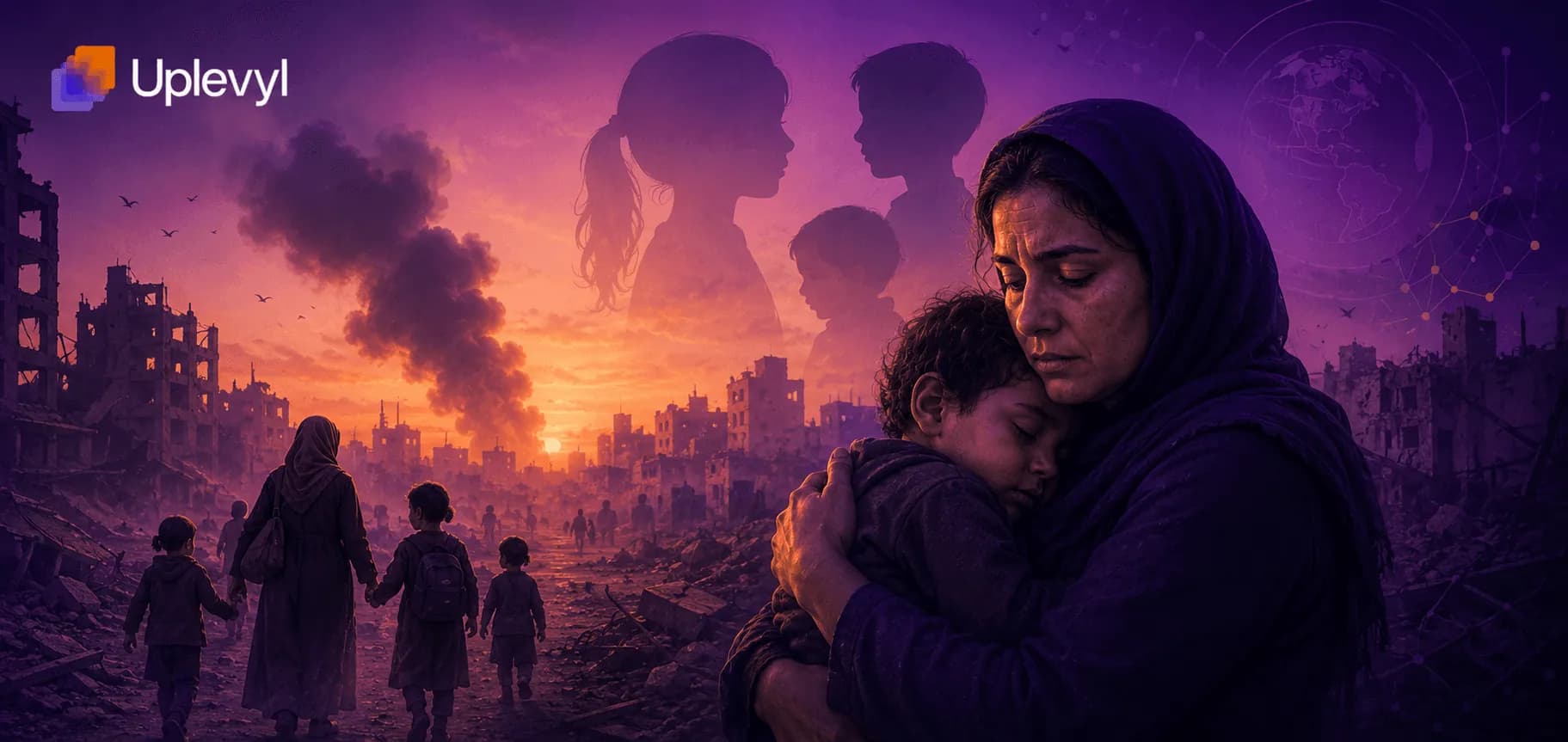
Note: The following contains content and details about the impacts of war on women, children, and communities. Read with care.
There is a tax that is levied without legislation, collected without consent, and paid almost exclusively by women and children. The currency of this tax is not money. It is safety, health, education, and survival itself.
Every war in recorded history has extracted this tax. The soldiers change. The borders shift. The weapons evolve. The tax stays the same.
What is happening right now in Ukraine, Gaza, and Iran is not an exception to this pattern. It is the pattern, running at scale, in real time, while the world watches and largely looks away.
When capital rewards scale and impunity, the infrastructure enabling harm becomes entrenched faster than the accountability meant to stop it.
Table of Contents
- The Body Is Always the First Battlefield
- What War Does to a Woman's Economic Life
- Where Do You Go When Home No Longer Exists?
- The Children Who Will Carry This Forward
- What AI Could Change and What It Cannot
- Frequently Asked Questions
-
The Body Is Always the First Battlefield
Sexual violence in conflict has been documented across centuries, and it is being deployed as such today.
In 2024, both state and non-state actors used sexual violence as a tactic of war, torture, terrorism, and political repression, according to the UN Secretary-General's most recent report on conflict-related sexual violence. Civilians were targeted with rape, gang rape, and abductions across an increasing number of conflict zones.
In Ukraine, sexual violence against women and girls has surged alongside displacement.
In Gaza, the UN Office of the High Commissioner for Human Rights found credible evidence of egregious violations against Palestinian women and girls, including arbitrary detention, rape, strip searches, and threats of sexual violence.
In Iran, the state itself is the perpetrator, executing women who protest and shielding men who kill women at home under the legal fiction of "honor."
What makes wartime sexual violence so structurally devastating is not only what it does to a body in the moment. It is what it does to a woman's life, and her community's life, in the decades that follow. Physical and psychological trauma, stigma, and compounding poverty affect survivors and their families for generations, according to the UN Special Representative for Sexual Violence in Conflict.
A woman who survives rape in a conflict zone frequently cannot return to her home, her marriage, her community, or her economic life. The violence follows her. Children born of rape, and their mothers, face heightened risk of community exclusion, and in some contexts, infanticide.
Sexual violence against children in conflict reached its highest verified level ever recorded in 2024, up 50% since 2020 (Source: UN Secretary-General's Report on Children and Armed Conflict, 2024)
A 16-year-old girl in eastern DRC told Save the Children: "When I got home, I remained calm and didn't talk to anyone. I decided not to go to the hospital because I was afraid and ashamed." She did not go because the system designed to protect her had already failed her before she arrived.
-
What War Does to a Woman's Economic Life
The economic destruction war inflicts on women is cumulative, compounding, and largely invisible to the recovery frameworks that follow.
When a woman is displaced, she does not simply lose her house. She loses her documentation, her employment history, her credit standing, her professional network, and frequently the childcare infrastructure that allowed her to work in the first place.
In Ukraine, women earned 41.4% less than men in 2023, doubling the pre-war pay gap in a single year, while spending 56 hours per week on childcare, up from 49 hours before the invasion.
Source: UN Women Ukraine Rapid Assessment, 2023
The women who survived the war were handed a second war immediately after: the war of rebuilding a life in conditions specifically engineered against them.
In Gaza, up to 83% of women in the most affected areas reported losing ownership documents, while between 48% and 80% face discrimination in claiming or retaining property due to inheritance laws and social norms. A woman who had a home, a shop, a lease, or a land title cannot prove it.
In Iran, women's labor force participation remains below 15%, not by accident but by legal design. A woman cannot travel, transact, or work on the same legal footing as a man. The economic consequences of this are not a side effect of Iran's governance. They are its purpose.
The same pattern holds across every documented post-conflict economy: women enter the recovery period with less capital, less legal standing, and more unpaid labor than before the war began.
-
Where Do You Go When Home No Longer Exists?
Displacement is the word the international community uses for what is, in practice, the destruction of the only world a woman and her children have ever known.
When families flee conflict, women and children do not flee to safety. They flee to a different kind of danger. Refugee camps carry elevated rates of sexual violence. Host communities with scarce resources direct them away from women without male heads of household. Borders that open for some stay closed for others.
For the women and children who make up the vast majority of Ukraine's 11 million displaced persons and refugees, the risk of being trafficked for sexual exploitation has persisted throughout displacement (Source: UNHCR Ukraine Situation Report, 2023-2024)
In Gaza, the majority of the female population has been forced to flee multiple times since October 2023. Each move meant finding a piece of land, building a makeshift shelter, and starting over in a place with fewer resources than the last. More than 16,000 women lost their husbands. One in seven families in Gaza is now headed by a woman who must simultaneously grieve and make life-or-death decisions alone, amid famine and collapsed services.
Homelessness in conflict is not like homelessness in peacetime. There is no shelter to walk into, no hotline to call, no social worker assigned to the case. There is a tent, a shared fire, and a child asking a question you cannot answer.
-
The Children Who Will Carry This Forward
Wars end. Their damage does not.
A child who witnesses sexual violence against a parent carries that in the body. A child who misses two years of school does not simply catch up when the bombs stop. A child who is malnourished in the first years of life sustains neurological consequences that no post-war curriculum can reverse.
More than 52 million children in conflict-affected countries are currently estimated to be out of school (Source: UNESCO Global Education Monitoring Report, 2024)
Without sustained intervention, the cycle of trauma unleashed perpetuates social fragmentation and lasting psychological harm, according to the UN Special Representative for Sexual Violence in Conflict.
What we are describing is not the tragedy of war. It is the design of it. Children are not accidentally caught in conflict. They are used as leverage, as territory, as proof of dominance.
When 19,000 Ukrainian children were forcibly relocated to Russia, it was not a logistical error.
When schools in Gaza were bombed, it was not a stray missile.
When girls in Iran are arrested for protesting, they are not collateral.
Each of these acts is deliberate. Each is a choice made by adults with power over children who have none.
-
What AI Could Change and What It Cannot
The oldest tax in the world is still being collected, from the same people, by the same systems. The question is not whether we know this. The question is what we are willing to do now that we do.
We are living through the dawn of AI and the tools are already here. The gap is not technological. It is one of will and resource allocation.
- AI systems that analyze satellite imagery can document the destruction of civilian infrastructure in real time, yet they are not deployed at the scale needed to build legal cases fast enough to matter.
- Natural language processing tools can reconstruct property and identity records for the millions of women in Gaza and Ukraine who lost everything they owned on paper, yet they are not in the hands of the organizations working with those women on the ground.
- Early warning models can detect the patterns, including hate speech spikes, troop movements, and displacement signals that precede mass atrocities, yet they remain underfunded and largely disconnected from the decision-makers who could act on them.
- AI-assisted mental health tools can reach survivors in conflict zones where there is not a single trained therapist within a hundred miles, yet they are not being built for the languages, the contexts, or the communities that need them most.
The technology has arrived. What has not arrived is the will to direct it toward the people paying the highest price. The question, as it has always been, is whose survival we decide to fund.
-
Frequently Asked Questions
-
Is sexual violence in conflict really a deliberate strategy, or is it opportunistic?
The UN Secretary-General's reports on conflict-related sexual violence document a consistent finding: in documented conflicts including Ukraine, the DRC, and Sudan, sexual violence is used as a tactic, not an accident. It is deployed to destabilize communities, punish perceived allegiances, and enforce territorial control. The pattern across conflicts is too consistent to be explained by opportunism alone.
-
How does economic harm after conflict specifically affect women differently than men?
Women in post-conflict economies face what researchers call a compounding deficit. Pre-war pay gaps widen under wartime conditions, documentation losses disproportionately affect women whose property rights are already fragile under customary or legal systems, and the unpaid care burden expands dramatically as infrastructure collapses. The UN Women Ukraine assessment showing a doubled pay gap in a single year is a documented, recent example of this acceleration.
-
What does AI realistically offer in conflict and post-conflict settings for women?
The most immediate applications are documentation and reconstruction. NLP tools can help reconstruct property records from fragmentary sources. Satellite analysis can generate legal evidence of infrastructure destruction. Mental health triage tools, if built in relevant languages and contexts, can extend reach where no trained providers exist. The barrier is not technical capability but deliberate investment in deploying these tools toward the most under-resourced populations.
-
Why are children specifically targeted in these conflicts?
The UN's reports on children and armed conflict document the use of children as both leverage and territory. Forcible transfer, recruitment, and attacks on schools are violations of international humanitarian law that have been used to reshape demographics and sever generational continuity. The 19,000 Ukrainian children forcibly relocated to Russia, documented by UNICEF and the UN Human Rights Monitoring Mission, represent one of the most clearly evidenced examples in recent history.
-
What can organizations and individuals do with this information?
The most direct interventions are funding and policy advocacy directed at the organizations doing documentation and legal accountability work, including the UN's conflict-related sexual violence mechanisms and organizations like the International Criminal Court supporting offices. For technologists and platform leaders, the actionable question is whether AI tools in development are being designed with conflict-affected and displacement contexts in mind, and whether the communities most affected have a voice in that design.