
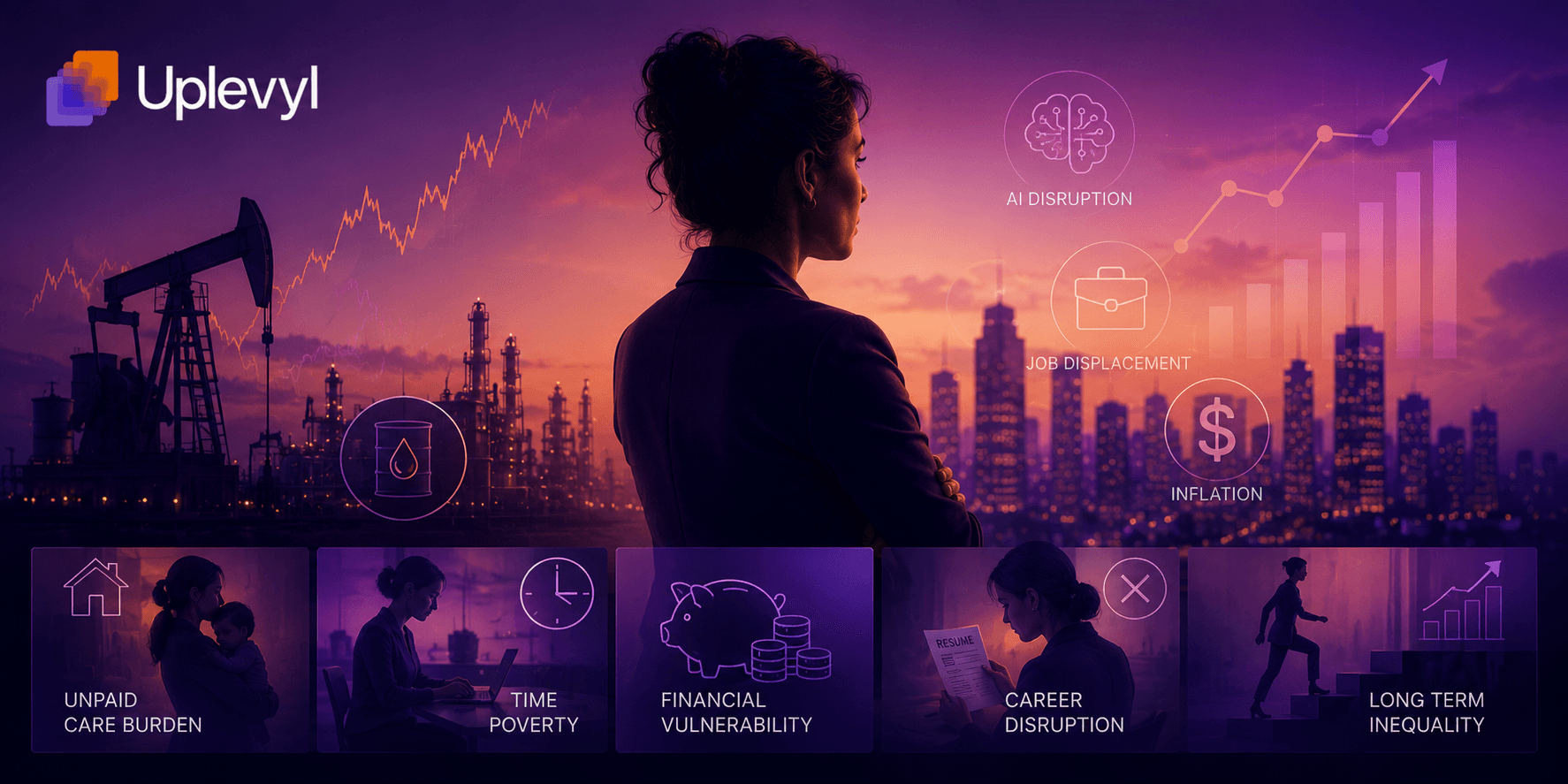
How Do Oil Crises Affect Women? (Part 2)
Table of Contents
Introduction
Are the Economic Shock Mechanisms of the 1970s Still Operational Today?
Why Does Greater Workforce Participation Actually Increase Exposure to Economic Disruption?
What Happens When AI Becomes the Oil Shock?
How Does Time Poverty Compound Every Other Dimension of Economic Fragility?
What Gets Measured Gets Managed -- So Why Aren't Companies Measuring This?
Is There a Single Solution to a Compounding Crisis?
FAQs
Introduction
In Part 1 of this series, we traced how the 1970s oil shocks moved through labor markets, household roles, and unpaid care, revealing a structural pattern the macroeconomic record was never designed to capture. Women absorbed the crisis at home while simultaneously entering a volatile labor market out of necessity, not opportunity.
Part 2 does not begin in the past. It begins now.
Energy markets remain volatile. Geopolitical tensions continue to shape oil prices. Inflation is still shaping everyday household decisions. Economic slowdowns are still rippling through labor markets. But layered on top of all of that is something the 1970s did not have: AI-driven job displacement, targeted with algorithmic precision at exactly the roles where women are most concentrated.
Are the Economic Shock Mechanisms of the 1970s Still Operational Today?
The short answer is yes, and the data is unambiguous about it.
When prices rise, real income falls. That effect is universal in theory, but not in practice. Women, on average, continue to earn less than men globally, which means inflation erodes their purchasing power faster and more deeply. When a household must absorb higher energy or food costs, the adjustment almost always falls on the person with the least financial buffer.
Women perform an average of 2.5 times more unpaid care work than men globally. When prices spike or services become unaffordable, the gap is absorbed by the same women. (Source: UN Women, 2024)
This is not new. What is new is the compounding velocity. The 1970s presented one acute shock followed by a slow recovery. The current environment stacks shocks: energy price volatility, post-pandemic inflation, supply chain disruption, and now AI-led labor market restructuring simultaneously, not sequentially.
The structural channels through which these shocks travel remain the same as they were fifty years ago. The volume passing through them has increased.
Why Does Greater Workforce Participation Actually Increase Exposure to Economic Disruption?
There is a counterintuitive dimension to women's current position in the labor market that is rarely named directly.
In the 1970s, the risk for many women was exclusion from the workforce during a time of crisis. Today, the risk is different: women are inside the workforce, in large numbers, and that presence has become a new form of exposure.
Dual-income households are now the norm in most advanced economies, and in many cases, both incomes are structurally essential not discretionary. When a disruption occurs, whether from inflation, a wave of layoffs, or AI-led restructuring, the impact is now immediate. Women are not trying to enter a destabilized market. They are already inside one, often with less financial cushion and more competing demands.
After economic shocks, women are 25% more likely than men to reduce working hours or exit the workforce entirely, primarily due to increased care demands (Source: ILO, 2024)
The 1970s risk was about entry. Today's risk is about retention.
"Greater participation without greater protection does not mean greater security. It means greater exposure."
The financial buffers that would allow women to weather a job loss or income reduction (emergency savings, retirement assets, wealth accumulated independent of a spouse or partner) remain significantly lower than men's across virtually every measure. Women retire with, on average, 30% less wealth than men, according to the World Economic Forum's Global Gender Gap Report 2023. That gap does not close during stable times. During disruption, it widens.
What Happens When AI Becomes the Oil Shock?
The 1970s crisis threatened women's jobs through macroeconomic contraction. Today's crisis threatens them through targeted automation. The parallel is not rhetorical; it is structural.
Administrative support, customer service, data entry, HR coordination, content moderation: these are not arbitrarily selected examples. They are the roles most exposed to generative AI displacement, and they are the roles where women are disproportionately concentrated. This is not coincidental. It is the consequence of decades of occupational segregation that directed women into rule-based, repeatable roles -- the precise category that machine learning systems are designed to absorb.
Women in high-income countries face nearly 3 times the automation risk that men do. In the U.S., administrative assistants (95% of them women) rank among the top five roles most vulnerable to AI displacement. (Source: ILO, 2024; National University, 2024)
But more important is what happens after the automation. These are not roles companies are rushing to reskill around. For many organizations, the calculation is straightforward: let the technology replace the function and absorb the headcount reduction quietly. The women holding those roles are handed a severance package, or nothing at all. There is no reskilling pipeline waiting on the other side.
This is the new stress layer. On top of inflation. On top of an existing wage gap. On top of unpaid care responsibilities. Women are now managing the anxiety of job preservation alongside everything else -- mirroring the compounding pressure that characterized 1970s households, but with one critical difference: the displacement is not the result of a supply shock that will eventually correct. It is structural, directional, and accelerating.
Reshma Saujani, founder of Moms First, has been direct about this: "We cannot talk about the future of work for women without talking about childcare, about the wage gap, about who gets reskilled and who gets left behind. These are not separate conversations." (Forbes, 2024)
How Does Time Poverty Compound Every Other Dimension of Economic Fragility?
What was once invisible is now documented, and the documentation is stark.
Economic stress does not just affect employment. It compresses time. Job instability and income pressure coincide with rising care responsibilities: schools become less accessible, healthcare harder to navigate, informal support systems weaker. The result is time poverty -- a simultaneous reduction in paid hours and an increase in unpaid labor, with no institutional mechanism to absorb the difference.
Women in time poverty save less, invest less, defer healthcare, and take on more debt to bridge gaps that income no longer covers. The financial cascade is predictable and measurable:
When oil prices rise, real wages fall. When real wages fall, discretionary savings disappear first.
When AI displaces a job, savings trajectory resets entirely. 401(k) contributions stop. Compounding stops.
The retirement shortfall, already significant, widens further.
Women who exit the workforce or reduce hours often lose employer-sponsored health coverage. Preventive care is deferred. Chronic conditions go unmanaged.
Women in the U.S. retire with approximately 30% less wealth than men. The gender pension gap across OECD countries averages 26%, and widens after economic disruptions. (Sources: World Economic Forum Global Gender Gap Report, 2023; OECD Pensions at a Glance, 2023)
This is the compounding effect the macroeconomic data still does not capture adequately. The 1970s data missed unpaid labor entirely. Today's data acknowledges it but rarely integrates it into the models that drive corporate or policy decision-making.
What Gets Measured Gets Managed, So Why Aren't Companies Measuring This?
For most companies, women's retention is not currently a strategic priority. AI is reducing headcount in exactly the functions where women are concentrated. The short-term financial calculus appears to favor replacement over reskilling.
But attrition driven by burnout, caregiving strain, or economic insecurity is preventable attrition. It is also invisible attrition: women who do not quit dramatically but simply reduce hours, disengage, or decline advancement opportunities because the margin has run out.
"What gets measured gets managed. Women's economic fragility inside organizations is not yet being measured with the same precision as quarterly earnings." - Stephanie Creary, Wharton School, 2023
The tools to change this now exist. Predictive analytics, workload monitoring, and AI-driven retention platforms are beginning to surface signals that were previously invisible. Stress can be identified before it leads to exit. Workload imbalances can be tracked in real time. Support can be targeted more precisely.
The question is not whether organizations have the tools. The question is whether they are choosing to deploy them before the cost has already been paid -- in attrition, in institutional knowledge lost, and in the widening of a gap they will eventually be asked to account for.
Is There a Single Solution to a Compounding Crisis?
No. And it is important to be honest about that.
The compounding effect described across this series operates simultaneously across multiple timescales and multiple systems. Oil price volatility is a macroeconomic force. AI-driven displacement is a structural labor market shift. The wage gap is a decades-old institutional failure. Unpaid care is a social norm embedded in both policy and culture. No single intervention addresses all four.
What is required is not a single solution but a set of coordinated responses, each operating at a different level:
At the policy level: economic shock policy must be designed with gender-disaggregated data, not assumed to be neutral because it applies to all workers equally.
At the organizational level: retention, reskilling, and care infrastructure must be treated as strategic priorities, not wellness add-ons.
At the measurement level: unpaid labor, time poverty, and gender-differentiated attrition must be tracked with the same rigor as financial performance metrics.
At the individual level: financial resilience strategies (emergency savings, independent retirement accounts, investment literacy) are protective factors that require active cultivation, not passive accumulation.
The macro impact is visible in aggregate labor data: reduced workforce participation, lower pension contributions, higher reliance on social safety nets at retirement. The micro impact is visible in individual households: deferred healthcare, interrupted savings, stretched credit.
Both are downstream consequences of systems that were not designed with women's economic fragility in mind. The 1970s demonstrated this. The current moment is demonstrating it again, with greater speed and greater precision.
Frequently Asked Questions
1. Why does the gender wage gap make oil price shocks worse for women specifically?
The wage gap means women begin any inflationary period with less financial buffer than men. When oil prices drive up the cost of food, energy, and transportation, the adjustment mechanism for lower-income households is not reduced spending on luxuries; it is reduced spending on essentials and increased unpaid labor. Because women are statistically more likely to be in the lower-income bracket of dual-income or single-income households, the adjustments fall on them first and most severely.
2. How is AI displacement different from previous waves of automation that also affected women's jobs?
Previous automation waves primarily targeted manual and manufacturing roles, where men were disproportionately concentrated. Generative AI targets cognitive and administrative functions, scheduling, writing, data processing, customer communication, which are the roles where women have historically been directed. This means the current wave is specifically more concentrated in women's employment than any prior technological disruption, and it is occurring at a speed that leaves inadequate time for organic labor market adjustment or reskilling.
3. What is 'time poverty' and why does it matter economically, not just personally?
Time poverty refers to the condition in which an individual has insufficient discretionary time after accounting for paid work, unpaid care, and personal maintenance. It matters economically because time is the prerequisite for investment in human capital: education, reskilling, networking, financial planning. Women in time poverty cannot pursue the activities that would improve their long-term economic position, creating a structural ceiling that income data alone does not capture. The ILO estimates that closing the time poverty gap would increase women's labor force participation rates significantly in most countries, with GDP effects in the trillions.
4. What should organizations actually measure to understand whether they are losing women to economic stress?
Beyond standard turnover metrics, organizations should track: voluntary reduction in hours among women in specific job categories; promotion decline rates (women declining advancement opportunities rather than being passed over); utilization rates of care benefits compared to demand signals; and aggregate health and absenteeism data disaggregated by gender and role type. These signals, taken together, can identify invisible attrition before it becomes departure. The Salesforce Nonprofit Trends Report (2025) and McKinsey Women in the Workplace (2024) both highlight how organizations that measure these dynamics more granularly are better positioned to intervene proactively.
This is Part 2 of a two-part series. Part 1 (click here to read) examined the structural dynamics of the 1970s oil crisis and what they revealed about who carries a macroeconomic shock.
How Do Oil Crises Affect Women? (Part 2)
Table of Contents
Introduction
Are the Economic Shock Mechanisms of the 1970s Still Operational Today?
Why Does Greater Workforce Participation Actually Increase Exposure to Economic Disruption?
What Happens When AI Becomes the Oil Shock?
How Does Time Poverty Compound Every Other Dimension of Economic Fragility?
What Gets Measured Gets Managed -- So Why Aren't Companies Measuring This?
Is There a Single Solution to a Compounding Crisis?
FAQs
Introduction
In Part 1 of this series, we traced how the 1970s oil shocks moved through labor markets, household roles, and unpaid care, revealing a structural pattern the macroeconomic record was never designed to capture. Women absorbed the crisis at home while simultaneously entering a volatile labor market out of necessity, not opportunity.
Part 2 does not begin in the past. It begins now.
Energy markets remain volatile. Geopolitical tensions continue to shape oil prices. Inflation is still shaping everyday household decisions. Economic slowdowns are still rippling through labor markets. But layered on top of all of that is something the 1970s did not have: AI-driven job displacement, targeted with algorithmic precision at exactly the roles where women are most concentrated.
Are the Economic Shock Mechanisms of the 1970s Still Operational Today?
The short answer is yes, and the data is unambiguous about it.
When prices rise, real income falls. That effect is universal in theory, but not in practice. Women, on average, continue to earn less than men globally, which means inflation erodes their purchasing power faster and more deeply. When a household must absorb higher energy or food costs, the adjustment almost always falls on the person with the least financial buffer.
Women perform an average of 2.5 times more unpaid care work than men globally. When prices spike or services become unaffordable, the gap is absorbed by the same women. (Source: UN Women, 2024)
This is not new. What is new is the compounding velocity. The 1970s presented one acute shock followed by a slow recovery. The current environment stacks shocks: energy price volatility, post-pandemic inflation, supply chain disruption, and now AI-led labor market restructuring simultaneously, not sequentially.
The structural channels through which these shocks travel remain the same as they were fifty years ago. The volume passing through them has increased.
Why Does Greater Workforce Participation Actually Increase Exposure to Economic Disruption?
There is a counterintuitive dimension to women's current position in the labor market that is rarely named directly.
In the 1970s, the risk for many women was exclusion from the workforce during a time of crisis. Today, the risk is different: women are inside the workforce, in large numbers, and that presence has become a new form of exposure.
Dual-income households are now the norm in most advanced economies, and in many cases, both incomes are structurally essential not discretionary. When a disruption occurs, whether from inflation, a wave of layoffs, or AI-led restructuring, the impact is now immediate. Women are not trying to enter a destabilized market. They are already inside one, often with less financial cushion and more competing demands.
After economic shocks, women are 25% more likely than men to reduce working hours or exit the workforce entirely, primarily due to increased care demands (Source: ILO, 2024)
The 1970s risk was about entry. Today's risk is about retention.
"Greater participation without greater protection does not mean greater security. It means greater exposure."
The financial buffers that would allow women to weather a job loss or income reduction (emergency savings, retirement assets, wealth accumulated independent of a spouse or partner) remain significantly lower than men's across virtually every measure. Women retire with, on average, 30% less wealth than men, according to the World Economic Forum's Global Gender Gap Report 2023. That gap does not close during stable times. During disruption, it widens.
What Happens When AI Becomes the Oil Shock?
The 1970s crisis threatened women's jobs through macroeconomic contraction. Today's crisis threatens them through targeted automation. The parallel is not rhetorical; it is structural.
Administrative support, customer service, data entry, HR coordination, content moderation: these are not arbitrarily selected examples. They are the roles most exposed to generative AI displacement, and they are the roles where women are disproportionately concentrated. This is not coincidental. It is the consequence of decades of occupational segregation that directed women into rule-based, repeatable roles -- the precise category that machine learning systems are designed to absorb.
Women in high-income countries face nearly 3 times the automation risk that men do. In the U.S., administrative assistants (95% of them women) rank among the top five roles most vulnerable to AI displacement. (Source: ILO, 2024; National University, 2024)
But more important is what happens after the automation. These are not roles companies are rushing to reskill around. For many organizations, the calculation is straightforward: let the technology replace the function and absorb the headcount reduction quietly. The women holding those roles are handed a severance package, or nothing at all. There is no reskilling pipeline waiting on the other side.
This is the new stress layer. On top of inflation. On top of an existing wage gap. On top of unpaid care responsibilities. Women are now managing the anxiety of job preservation alongside everything else -- mirroring the compounding pressure that characterized 1970s households, but with one critical difference: the displacement is not the result of a supply shock that will eventually correct. It is structural, directional, and accelerating.
Reshma Saujani, founder of Moms First, has been direct about this: "We cannot talk about the future of work for women without talking about childcare, about the wage gap, about who gets reskilled and who gets left behind. These are not separate conversations." (Forbes, 2024)
How Does Time Poverty Compound Every Other Dimension of Economic Fragility?
What was once invisible is now documented, and the documentation is stark.
Economic stress does not just affect employment. It compresses time. Job instability and income pressure coincide with rising care responsibilities: schools become less accessible, healthcare harder to navigate, informal support systems weaker. The result is time poverty -- a simultaneous reduction in paid hours and an increase in unpaid labor, with no institutional mechanism to absorb the difference.
Women in time poverty save less, invest less, defer healthcare, and take on more debt to bridge gaps that income no longer covers. The financial cascade is predictable and measurable:
When oil prices rise, real wages fall. When real wages fall, discretionary savings disappear first.
When AI displaces a job, savings trajectory resets entirely. 401(k) contributions stop. Compounding stops.
The retirement shortfall, already significant, widens further.
Women who exit the workforce or reduce hours often lose employer-sponsored health coverage. Preventive care is deferred. Chronic conditions go unmanaged.
Women in the U.S. retire with approximately 30% less wealth than men. The gender pension gap across OECD countries averages 26%, and widens after economic disruptions. (Sources: World Economic Forum Global Gender Gap Report, 2023; OECD Pensions at a Glance, 2023)
This is the compounding effect the macroeconomic data still does not capture adequately. The 1970s data missed unpaid labor entirely. Today's data acknowledges it but rarely integrates it into the models that drive corporate or policy decision-making.
What Gets Measured Gets Managed, So Why Aren't Companies Measuring This?
For most companies, women's retention is not currently a strategic priority. AI is reducing headcount in exactly the functions where women are concentrated. The short-term financial calculus appears to favor replacement over reskilling.
But attrition driven by burnout, caregiving strain, or economic insecurity is preventable attrition. It is also invisible attrition: women who do not quit dramatically but simply reduce hours, disengage, or decline advancement opportunities because the margin has run out.
"What gets measured gets managed. Women's economic fragility inside organizations is not yet being measured with the same precision as quarterly earnings." - Stephanie Creary, Wharton School, 2023
The tools to change this now exist. Predictive analytics, workload monitoring, and AI-driven retention platforms are beginning to surface signals that were previously invisible. Stress can be identified before it leads to exit. Workload imbalances can be tracked in real time. Support can be targeted more precisely.
The question is not whether organizations have the tools. The question is whether they are choosing to deploy them before the cost has already been paid -- in attrition, in institutional knowledge lost, and in the widening of a gap they will eventually be asked to account for.
Is There a Single Solution to a Compounding Crisis?
No. And it is important to be honest about that.
The compounding effect described across this series operates simultaneously across multiple timescales and multiple systems. Oil price volatility is a macroeconomic force. AI-driven displacement is a structural labor market shift. The wage gap is a decades-old institutional failure. Unpaid care is a social norm embedded in both policy and culture. No single intervention addresses all four.
What is required is not a single solution but a set of coordinated responses, each operating at a different level:
At the policy level: economic shock policy must be designed with gender-disaggregated data, not assumed to be neutral because it applies to all workers equally.
At the organizational level: retention, reskilling, and care infrastructure must be treated as strategic priorities, not wellness add-ons.
At the measurement level: unpaid labor, time poverty, and gender-differentiated attrition must be tracked with the same rigor as financial performance metrics.
At the individual level: financial resilience strategies (emergency savings, independent retirement accounts, investment literacy) are protective factors that require active cultivation, not passive accumulation.
The macro impact is visible in aggregate labor data: reduced workforce participation, lower pension contributions, higher reliance on social safety nets at retirement. The micro impact is visible in individual households: deferred healthcare, interrupted savings, stretched credit.
Both are downstream consequences of systems that were not designed with women's economic fragility in mind. The 1970s demonstrated this. The current moment is demonstrating it again, with greater speed and greater precision.
Frequently Asked Questions
1. Why does the gender wage gap make oil price shocks worse for women specifically?
The wage gap means women begin any inflationary period with less financial buffer than men. When oil prices drive up the cost of food, energy, and transportation, the adjustment mechanism for lower-income households is not reduced spending on luxuries; it is reduced spending on essentials and increased unpaid labor. Because women are statistically more likely to be in the lower-income bracket of dual-income or single-income households, the adjustments fall on them first and most severely.
2. How is AI displacement different from previous waves of automation that also affected women's jobs?
Previous automation waves primarily targeted manual and manufacturing roles, where men were disproportionately concentrated. Generative AI targets cognitive and administrative functions, scheduling, writing, data processing, customer communication, which are the roles where women have historically been directed. This means the current wave is specifically more concentrated in women's employment than any prior technological disruption, and it is occurring at a speed that leaves inadequate time for organic labor market adjustment or reskilling.
3. What is 'time poverty' and why does it matter economically, not just personally?
Time poverty refers to the condition in which an individual has insufficient discretionary time after accounting for paid work, unpaid care, and personal maintenance. It matters economically because time is the prerequisite for investment in human capital: education, reskilling, networking, financial planning. Women in time poverty cannot pursue the activities that would improve their long-term economic position, creating a structural ceiling that income data alone does not capture. The ILO estimates that closing the time poverty gap would increase women's labor force participation rates significantly in most countries, with GDP effects in the trillions.
4. What should organizations actually measure to understand whether they are losing women to economic stress?
Beyond standard turnover metrics, organizations should track: voluntary reduction in hours among women in specific job categories; promotion decline rates (women declining advancement opportunities rather than being passed over); utilization rates of care benefits compared to demand signals; and aggregate health and absenteeism data disaggregated by gender and role type. These signals, taken together, can identify invisible attrition before it becomes departure. The Salesforce Nonprofit Trends Report (2025) and McKinsey Women in the Workplace (2024) both highlight how organizations that measure these dynamics more granularly are better positioned to intervene proactively.
This is Part 2 of a two-part series. Part 1 (click here to read) examined the structural dynamics of the 1970s oil crisis and what they revealed about who carries a macroeconomic shock.