"Learn AI" is too broad to be useful. Here is what is actually changing and what to do about it.
By Shubhi Rao, Founder & CEO, Uplevyl
My son is 25. He and his friends graduated into a job market that looked more or less like the one I navigated: show up, learn the ropes, earn your way into responsibility. Then, in the space of about eighteen months, the workforce they entered started to shift. This shift has also led to increasingly having conversations with mentees and friends who have been laid off or are quietly anxious. Some are accomplished and senior, suddenly unsure whether what they have spent years building still matters.
And then there is the shift that I am seeing with our own company. Here is an example:
At Uplevyl, one of our core engineering workflows is creating unit test cases to rigorously validate our code. In the early days, experienced engineers built those test cases by hand. A couple of years ago, we started using tools to assist. This past weekend, we used Claude to generate comprehensive test cases, run the code against them, identify issues by feature type, describe each issue, and produce the fix. Work we scoped for a month got done in six hours. We have scores of examples like this now.
This shift I am seeing happening internally and externally is what prompted me to write this.
We Are Not Talking About Tools Anymore
For the past three years, the workplace conversation about AI has been about assistance. Faster drafts. Smarter search. Better summaries. Technology helping humans do their jobs a little more efficiently.
That era is ending.
We are entering the Agentic Economy.
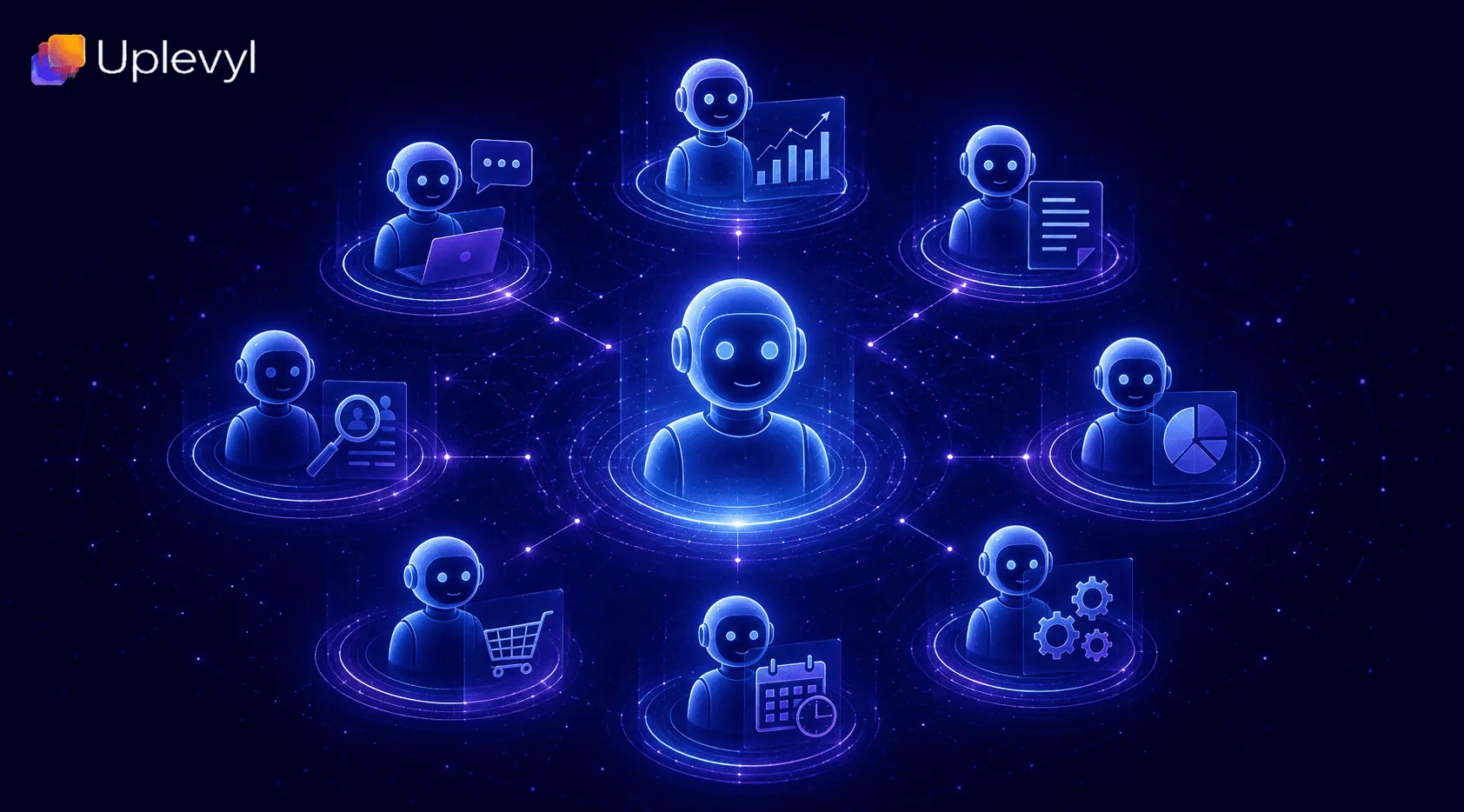
In this economy, the workplace is where AI systems no longer just answer questions or generate drafts, but increasingly plan, execute, coordinate, and close the loop without waiting to be asked at each step.
Just last month, we saw tools that are being shipped are categorically different. Anthropic's Claude Opus 4.6 is built around longer-running agentic tasks: systems that plan, reason across workflows, and execute multi-stage work autonomously. Cursor, from Anysphere, has turned AI into an active coding coworker, not just a writing assistant. Perplexity's Computer is a cloud-based agent built for multi-step tasks.
These are not assistant products. They are products that do the work.
The biggest mistake people are making right now is assuming this is primarily a story about software engineers. It is not.
The Jobs Most Exposed Are Not Only in Engineering
The functions most vulnerable right now are built around structured, repeatable, screen-based knowledge work. Think carefully about what that actually describes.
- In customer success, an agent can prep account briefs before renewal calls, summarize every prior support interaction, draft follow-ups, flag churn risks, and generate next-step recommendations.
- In operations, an agent can reconcile spreadsheets, move data between systems, monitor exceptions, prepare weekly reports, and update standard operating documents.
- In HR and recruiting, an agent can screen resumes, draft job descriptions, answer policy questions, schedule interviews, and build onboarding checklists.
- In marketing, an agent can generate campaign variants, repurpose content, summarize competitive activity, draft newsletters, and build reporting packs.
- In finance support and administration, an agent can organize receipts, classify spend, prepare summaries, assemble board materials, maintain folders, and coordinate calendars.
- In research, an agent can scan academic papers, policy reports, and news sources, synthesize findings across dozens of documents, surface relevant data points, and produce structured summaries ready for grant applications or program design.
- In program and grants management, an agent can track reporting deadlines, compile outcome data from multiple sources, draft funder updates, flag budget variances, and maintain the documentation trail that compliance and audits require.
These are not niche functions. They describe the daily work of tens of millions of people across organizations in America, and they are precisely the roles that agentic AI is designed, built, and now actively deployed to absorb.
None of this means the human disappears overnight. It means the execution layer is being compressed, faster than most organizations are ready to admit, and faster than most employees have been told.
The Hidden Cost: We Are Losing the Training Layer
Here is what corporate America is still underestimating.
Most organizations have operated for decades like a pyramid. At the base sits the broadest layer: individual contributors doing execution-heavy work, gathering information, drafting, coordinating, analyzing, reporting, reconciling, following process. Above them sit progressively smaller layers of managers and leaders who direct, review, decide, and navigate ambiguity.
As agents absorb the structured execution layer, this is the single most consequential disruption. Not just to jobs, but to the entry point of the pyramid itself. It is where people learned the business, built judgment, developed pattern recognition, and earned their way into bigger responsibility. That is how careers have always worked: you did the work, then you understood the work, then you led the work.
If that layer gets compressed, the entire model of career development changes. Not just the jobs, but the path into them.
And it produces a shift that most organizations are not yet prepared for:
Many employees in entry-level and junior roles will need to become managers much earlier. Except what they manage may not be a team of humans. It will be a team of agents.
What the Human Employee Actually Does Next
"Higher-order work" is not wrong. It is just too vague to act on. Here is what it actually means in practice.
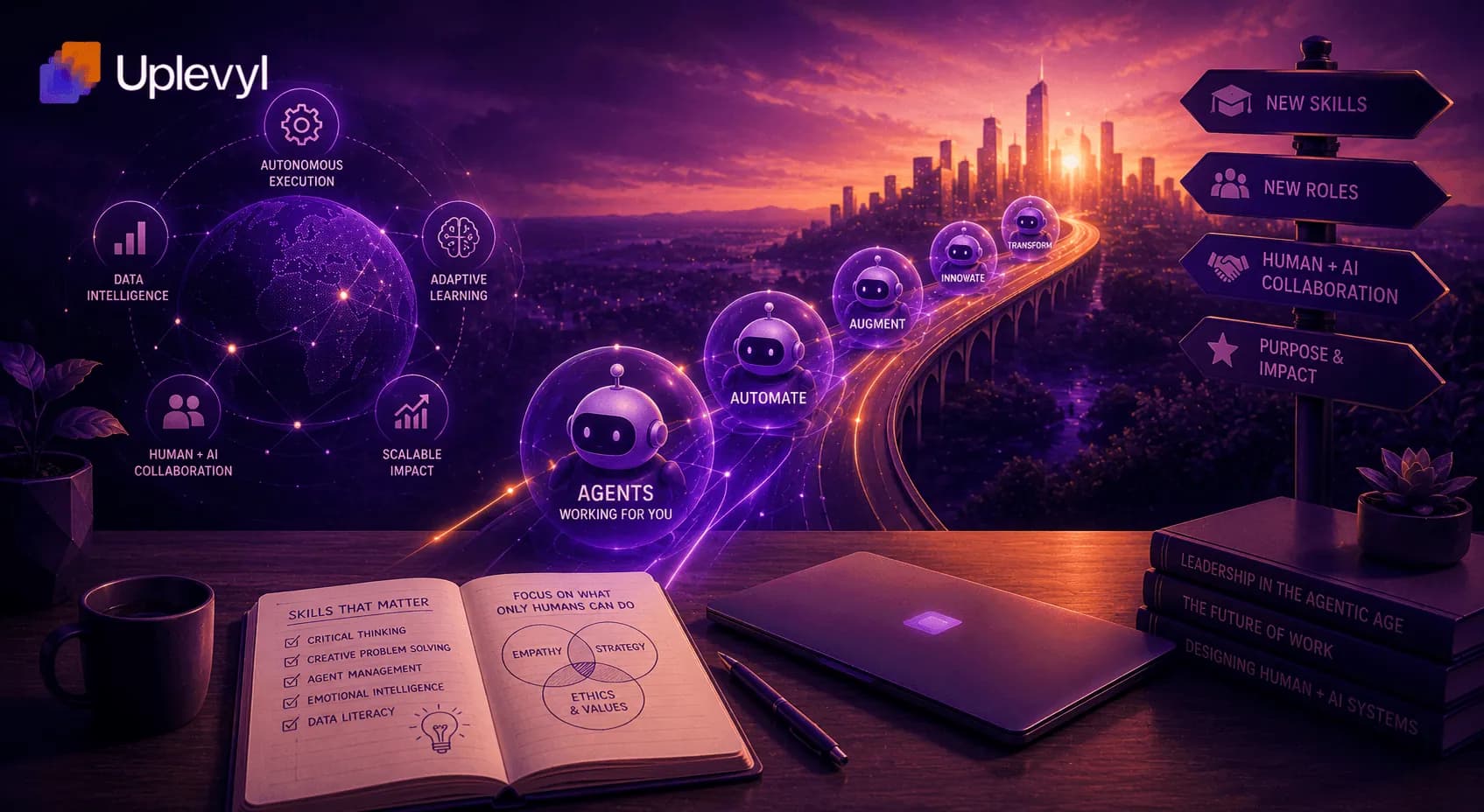
- Delegation and work design. The new baseline skill is knowing what should be handed to software, what requires human judgment, what needs review, what needs guardrails, and what should never be automated without oversight. This is not a technical skill. It is a management skill, and it now starts at the individual contributor level.
- Judgment under uncertainty. As AI systems produce more content, analysis, and recommendations, someone still has to decide whether the output is right, whether the reasoning is thin, whether context was missed, whether the system overstepped. The more fluent AI becomes, the more dangerous it is to confuse polish with accuracy.
- Workflow redesign. Some employees will spend the next two years trying to protect yesterday's tasks. Others will learn how to redesign work for the new environment. McKinsey is explicit: the economic value of agentic AI depends on workflow redesign, not simply access to powerful models. The second group will win.
- Managing blended labor. The future employee will increasingly manage output from software agents, reviewing their work, handing tasks between human and digital teammates, maintaining quality across both. The new baseline is not being a strong individual contributor. It is being a capable manager of a mixed workforce.
- Staying current without drowning in it. The release cadence in AI is relentless. Anthropic launched more than thirty products and features in January 2026 alone. You do not need to obsess over every headline. But not paying attention now has a real, compounding cost.
What I Tell My Mentees and Friends Who Are Worried
I do not tell them to panic. Everything they have built is not suddenly worthless.
I also do not tell them to casually "learn AI" because that phrase alone is not guidance.
What I tell them is this: the economy is shifting from one where humans performed most of the execution and software mostly supported them, to one where software increasingly executes and humans must guide, evaluate, constrain, and redesign.
Your edge will come from being able to define the work, shape the workflow, judge the output, manage ambiguity, and lead people through change.
That is what I want my son to focus on. It is what I want every mentee and friend navigating this shift to understand.
You do not have to know everything. But you do have to pay attention. You do have to start seeing work differently.
The people who adapt to this shift will not just survive it. They will be the ones running it.
In my next piece (click here to read it), I will get into the HOW: what it actually means to build agent literacy, why you have to build agents yourself rather than just read about them, and a simple real-world example from my own home that anyone can replicate safely this week.