
Automated reproductive health workflows that save hundreds of work hours to surface protections and benefits by jurisdiction
Every state sets its own reproductive health rules. Whether the right reaches the person depends on the state, plan and the conditions attached. This requires a complete evergreen jurisdictional mapping so that employers, providers and buyers can have this information at their fingertips.
A right can exist but may not be relevant to everyone
Federal law may set a floor for some rights, but for some laws like cancer screening there is no federal rule at all, and whatever protection exists is fragmented by how individual states have chosen to write.
State may add to that floor, or narrow it: The same right can be guaranteed in one state, conditional in the next, and absent in the one after that.
The plan may reach, or sit outside: State insurance mandates do not touch self-funded employer plans, which is how most working people in the country are covered. A mandate can exist and simply not apply to the situation.
The eligibility conditions: Age, timing, prior authorization, documentation, consent each written separately within the law.
Every one of these has to hold true for the right to apply. It is very challenging to navigate through these complexities without help.
One Answer Takes Three Coordinates
Every rule we have found so far sits somewhere in the graph representation below. Between different kinds of rights, four levels of jurisdictions. Different ways of eligibility getting decided. One person's situation is a single dot in that space which has its own unique attributes and conditions. Imagine 5 billion+ such dots.


The response has to be in the context of the individual.
Knowing the state, the right, or their own circumstances is not enough on its own. For every jurisdiction, we have to figure out which are all the applicable subtopics, and then which of those subtopics carry eligibility criteria – the conditions a person has to meet for a law to apply to them.
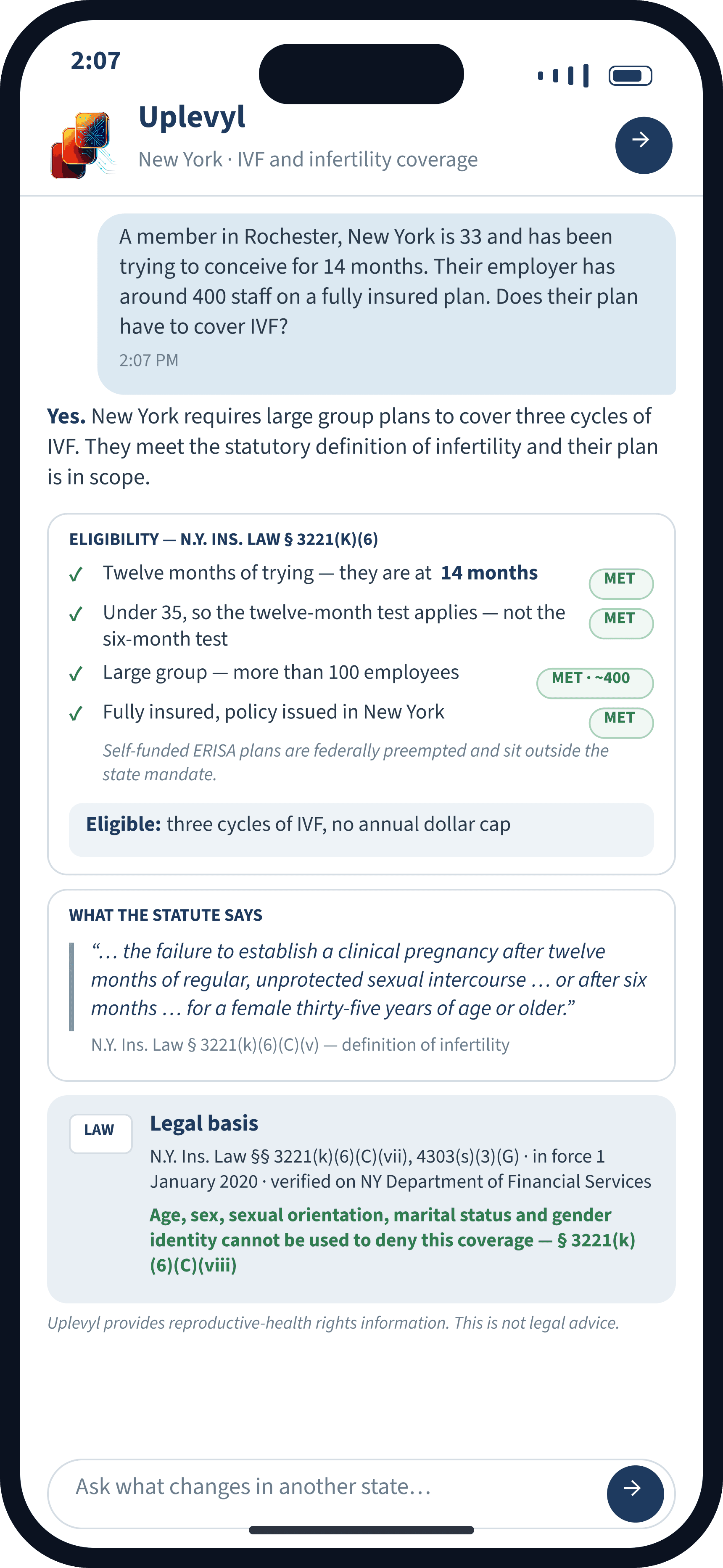
Take one real case. Someone needs IVF and works for a private employer in Texas. Texas law requires insurers to offer IVF coverage – but the employer decides whether to take it. There is no federal rule underneath. So if their employer said no, they have no coverage. The person next door, whose employer said yes, does. Same state, same statute, different answer, and nothing about the state or the law decides this.
Tex. Ins. Code §1366.003 and ch. 1366 (offer mandate) · no federal IVF coverage mandate exists
What changes when the organized data and workflow exists?
There are only so many lawyers, and only so many human hours. To solve this, first we build the trusted dataset. Every law is pulled from the official government source that published it, checked against the official text, and filed with its metadata. Laws pass, change and get struck down – every change re-enters the machine and the record is updated.
Then we build the workflow on top of it. A question arrives in plain language. The workflow asks back only what it needs – where they are, what they need, whether they qualify – and fetches the exact text that applies. Every answer names the law it came from, so it is trustworthy.
Who this tool can serve
- A provider – the clinic running IVF, surrogacy or cervical screening
- A physician – needs to know whether the law protects them
- An employer – deciding what to cover, and what is already required
- A buyer – a health plan asking what its members are entitled to, state by state
- A legislator – drafting a bill
- A researcher – asking where the gaps are
- The individual – asking about their own situation directly
Built once, one knowledge layer serves every one of them without adding human cost.
Imagine the insights this unlocks.
With all laws in one place, analytics can start answering some of the toughest questions from Day 1 and then slowly as people start using the tool, the data can address more dynamic and critical questions based on the usage.
- Static data — question that can be answered from the actual law
- "Which states protect reproductive health data, and which stay silent?"
- "Which cities and counties protect people their state does not?"
- "Where does a law exist, but the eligibility rules leave most people outside it?"
- Dynamic — based on people usage and request
- "What is top of mind this month, and in which states?"
- "What are people asking that no law answers?"
- "Are these laws reaching the people they were written for?"

For your legal and data teams, before they ask.
- Every law is pulled from the official government source that published it. Primary citations only.
- Every record is checked against the official text. Anything uncertain goes to a team of experts for review.
- Laws pass, change, and get struck down. Every change re-enters the machine and the record is updated.
- There is no record of who asked what, only the anonymous pattern.
- Nothing goes out unchecked. Every answer names the law it came from, so anyone can check it.
- Built from public research and licensed sources.
Our promise as a partner

Safety first, built into everything
We take trust and safety seriously from the very beginning. Everything we build protects people’s information through strong privacy practices, secure systems, and limited access. Our tools have built-in safety checks and clear boundaries so people can use them confidently and without slowing down.

High impact, sensible costs
We believe resources should go toward making a real difference, not extra expenses. That’s why we create powerful AI tools that are easy to use and don’t cost a fortune. You get the strength of high-end technology at a price that works for real organizations doing important work.

Partner‑level CTO services
We work with you as a hands‑on product and engineering partner. We co‑solution your roadmap, architecture, integrations, and governance, ship stable releases, and de‑risk decisions so your team moves faster with clarity and assurance.

Let's connect
Get in touch with us to explore what’s the best, customized solution for your team or organization.